
Getting Out and About in Later Life — How Whitchurch and Wem Are Changing for the Better
There is a particular kind of confidence that comes from knowing your town works for you.
Not just the routes you know by heart, but the crossing that holds long enough for you to reach the other side comfortably. The pavement that doesn't surprise you with a level change. The bus that meets the kerb properly. The bench that appears when you need it.
For younger adults these details barely register. For someone navigating their seventies or eighties — perhaps with a walking stick, perhaps with a hearing aid, perhaps simply with the slightly reduced reaction times that come quietly with age — they are the difference between going out and staying in. Between independence and isolation. Between a town that includes you and one that has quietly stopped doing so.
The good news, if you live in Whitchurch or Wem, is that the infrastructure around you is changing. Not fast enough, and not without its frustrations — but changing. And understanding what is being done, and why, is a useful thing for older residents and their families.
The Hidden Engineering of a Good Crossing
Most people cross a road without thinking about it. For anyone with reduced mobility, slower processing speed, or impaired vision — all of which are normal features of ageing rather than exceptional circumstances — a busy road crossing is a genuine exercise in risk management.
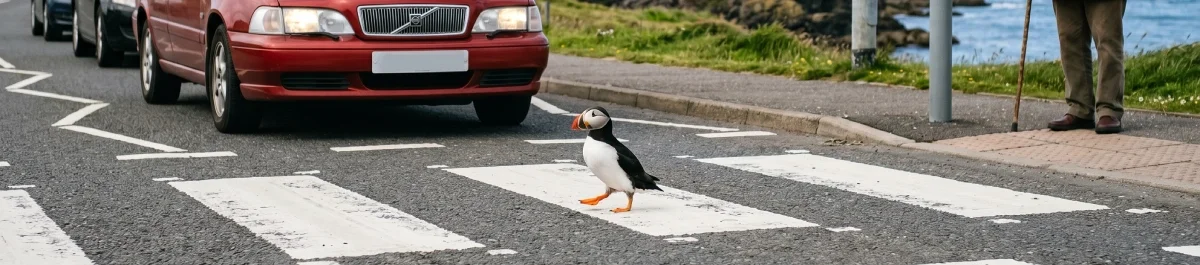
The UK has been quietly upgrading its crossings for years. The older Pelican crossing — where the green man appears on the far side of the road, requiring you to look across a wide carriageway to see whether it is safe to go — has been gradually replaced by the Puffin crossing (Pedestrian User-Friendly Intelligent crossing, if you want the full name, which almost nobody does). The distinction matters: on a Puffin crossing, the signal is on the pole right beside you, so you are not straining ageing eyes across a busy junction.
More significantly, Shropshire Council maintains and inspects its traffic signals and crossings across the county, and Puffin crossings use sensors to detect whether a pedestrian is still on the crossing — holding the red light for traffic until the person has safely reached the other side. For someone who walks more slowly than the assumed pace, this makes the crossing usable rather than hazardous.
At crossings with a central island, tactile paving is provided where pedestrians are expected to cross in two halves — allowing a slower-moving person to pause safely mid-road rather than attempting the full width in one go. The blistered surfaces you feel underfoot at dropped kerbs were originally designed for visually impaired pedestrians, but they benefit anyone whose attention or vision makes a level change easy to miss.
Whitchurch Specifically: What Is Being Planned
Whitchurch is one of seven towns in Shropshire — the only North Shropshire town on the list — that Shropshire Council has prioritised in its Local Cycling and Walking Infrastructure Plan (LCWIP), a programme aimed at dramatically improving the safety, comfort and attractiveness of walking in the town.
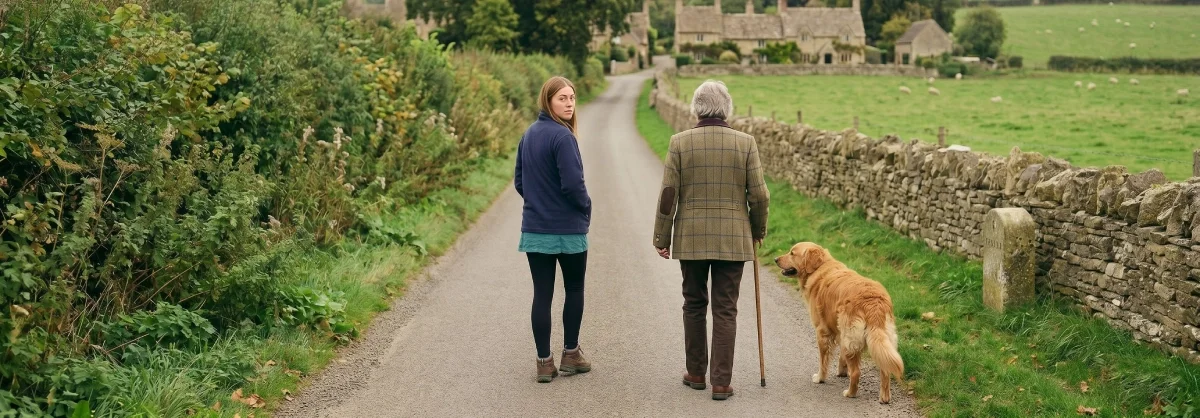
The plan acknowledges Whitchurch's particular challenges directly: a relatively hilly town centre, narrow streets that produce narrow pavements and blind corners, and a fragmented existing network. These are the features that make getting around on foot genuinely difficult — not because the town is poorly designed by historical standards, but because a town built for a different era of transport creates real friction for pedestrians who need clear, level, predictable routes.
The highest-priority scheme identified for Whitchurch is along Station Road, enhancing the link between the station and the town centre. The second highest is on Claypit Street, supporting access to Whitchurch Community Hospital — which is, notably, one of the most important routes for older residents making regular journeys to and from healthcare appointments.
Plans also include enhancing paths through Jubilee Park to act as a hub for active travel in Whitchurch, potentially including a mobility hub — which, if it materialises, would make the park not just a green space but a practical staging point for people making their way around the town on foot or by mobility aid.
In February 2025, Shropshire Council was awarded more than £650,000 from Active Travel England to enhance walking and cycling infrastructure across the county, with the funding aimed at creating new pathways, enhancing existing routes, and implementing safety measures. The specific Whitchurch schemes that will benefit from this funding are yet to be confirmed, but the direction of travel is clear.
The Civic Centre Gap
There is, however, a significant local accessibility story that deserves honest acknowledgment rather than just optimism about future plans.
Whitchurch Civic Centre has been closed since September 2023 — except for the sports and market hall — after specialist engineers found that reinforced autoclaved aerated concrete (RAAC) exists across the majority of the complex and that it has major structural issues.
A needs analysis report was commissioned by Shropshire Council's Cabinet in February 2025 and the aspiration is now to potentially redevelop the site and create a new, modern, fit-for-purpose and energy-efficient building. The working group considering the future of the site has been looking at what space and facilities should be provided, parking requirements, and whether it should be a single-storey building — the last of which is a significant accessibility consideration.
For older residents who used the Civic Centre regularly — for community groups, health appointments, social activities — its closure has been a real loss. The redevelopment, when it comes, is an opportunity to build something genuinely designed around the needs of the whole community, including those for whom level access, proximity to parking, and clear wayfinding are not preferences but requirements.
On a more immediately positive note, the new Whitchurch Swimming and Fitness Centre opened in March 2025 — a significant community facility that offers accessible leisure and exercise options for residents of all ages and abilities.
The Pavement Sandwich Board Problem
One thing we notice constantly in our daily work across Whitchurch and Wem: the pavements.
"Age-friendly" urban design emphasises what planners call decluttering — the removal of redundant signposts, advertising boards, and the proliferating A-frame sandwich boards that many local businesses place on pavements outside their premises. For most pedestrians these are a minor inconvenience. For someone using a walking frame or a mobility scooter, navigating a narrow pavement already compressed by a parked car on one side and a cafe's specials board on the other is a genuinely difficult obstacle. For someone with a visual impairment, it can be dangerous.
We would personally like to see less pavement signage on the main streets of both Whitchurch and Wem — not because we begrudge local businesses their advertising (we love local!), but because the cumulative effect on pavement accessibility is real and largely invisible to people who don't experience it daily. It is the kind of small, unfashionable improvement that makes an enormous practical difference and rarely gets into the plans.
Designing for Eyes That Have Changed
Vision changes significantly with age. The ability to distinguish an object from its background — what opticians call contrast sensitivity — diminishes. More light is needed to see the same level of detail. Glare becomes more disabling. A grey bollard on grey pavement, invisible to the eye of a forty-year-old, is genuinely hazardous to someone in their late seventies.
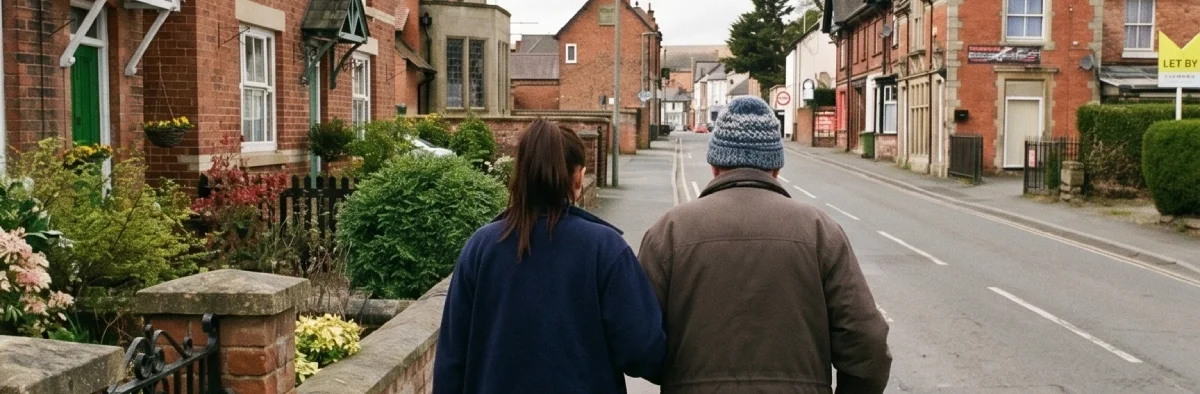
This is why local councils are required to ensure street furniture contrasts sharply with its surroundings — the high-visibility banding on bollards is not a design quirk, it is a specific response to the visual changes of ageing. The white zig-zag lines at crossings that prohibit parking exist partly because an older or shorter pedestrian needs a clear sightline to oncoming traffic, undisrupted by parked vehicles.
The same principle applies indoors. When Whitchurch's Brownlow Community Centre in Claypit Street received accessibility funding in 2022, it invested in replacing old heavy wooden doors with automatic ones at both entrances — wider, easier to open, and removing barriers for those with mobility issues or using wheelchairs. That is a small building change with a large practical effect: the difference between a community building that is nominally accessible and one that actually is.
The Rural Question Nobody Asks Enough
All of the above concerns the town centres. Our operating area extends well beyond them.
For residents in Whixall, Tilstock, Higher Heath, Prees, and Ash — the villages and rural properties that make up a significant part of the community we serve — the engineering solutions described above are largely irrelevant, because the infrastructure simply does not exist in the same way. There are no Puffin crossings on a country lane. There are no benches every fifty metres along a field path. The nearest bus stop may be a mile away, and the service may run twice a day.

For older people in rural North Shropshire, independence is not primarily a question of urban design. It is a question of transport — specifically the loss of it. The moment a driving licence is surrendered or a car becomes too difficult to manage is the moment the world changes fundamentally for a rural resident in a way it simply does not for someone living in a market town.
This is not a problem that Shropshire Council's cycling and walking plan solves. It is the problem that, more than any other single factor, drives the need for the kind of support we provide. A carer who accompanies someone to Whitchurch on a Friday morning is not just helping with the shopping. They are maintaining access to a world that would otherwise have contracted to the boundaries of a garden.
Keeping the World the Right Size
There is a phrase we come back to often in this work: the world should not shrink.
The physical changes that come with ageing — reduced mobility, changing vision, slower reactions — are real. But they do not have to mean a smaller life. They mean a life that requires more thoughtful support: from the town's infrastructure, from the people around you, and sometimes from a professional carer who is there to make the things you want to do possible rather than optional.
Whitchurch is changing for the better. The plans being made now — the walking routes, the improved crossings, the new community facilities — will make the town more navigable for everyone, and particularly for the people who need it most. We are glad those plans exist and we will be glad when they are built.
In the meantime, the lanes between our villages are what they are. And for the people who live on them, we are here.
North Shropshire Homecare The Coach House, 15/17 Green End, Whitchurch, SY13 1AD Tel: 01948 411222 | mail@nshomecare.co.uk
If getting out has become more difficult — whether in town or in the villages — we would be glad to help. Our Shopping and Companionship services exist precisely for this.
Sources & Further Reading
Whitchurch as a priority town for walking improvements Shropshire Council's Local Cycling and Walking Infrastructure Plan (LCWIP) identifies Whitchurch as one of seven priority towns in the county for pedestrian and cycling infrastructure improvements, acknowledging the town's narrow pavements, hilly centre, and fragmented walking network. Read the Whitchurch LCWIP
Station Road and Claypit Street as priority schemes The highest-scoring proposed improvement for Whitchurch is along Station Road, connecting the station to the town centre. The second is on Claypit Street, improving access to Whitchurch Community Hospital. Shropshire Council newsroom, March 2023
Jubilee Park mobility hub proposal Plans include enhancing paths through Jubilee Park to act as a hub for active travel in Whitchurch, potentially including a mobility hub. Whitchurch cycling schemes, Shropshire Council
£650,000 Active Travel England funding In February 2025, Shropshire Council was awarded £659,392 from Active Travel England to enhance walking and cycling infrastructure across the county, aimed at creating new pathways and improving existing routes. Shropshire Council newsroom, February 2025
Whitchurch Civic Centre closure and redevelopment The Civic Centre has been closed since September 2023 following the discovery of structurally unsafe RAAC concrete throughout the building. As of mid-2025, the preferred option is full redevelopment of the site into a new, modern, single-storey building. The working group includes Shropshire Council, Whitchurch Town Council, and local MP Helen Morgan. Shropshire Council newsroom, August 2025Working group update, September 2025
Whitchurch Swimming and Fitness Centre The new Whitchurch Swimming and Fitness Centre opened in March 2025, ahead of its originally scheduled date. Shropshire Council newsroom, February 2025
Brownlow Community Centre accessibility improvements Whitchurch's Brownlow Community Centre on Claypit Street received grant funding in 2022 to replace heavy wooden doors with automatic, wider entrances and install a new disabled parking area — specifically to improve access for visitors with mobility issues or using wheelchairs. Shropshire Council newsroom, October 2022
Shropshire Council pedestrian crossing standards Shropshire Council's traffic signals team maintains all crossings across the county, including Puffin crossings with on-crossing sensors and audible signals, and provides specific pedestrian facilities for people with disabilities including tactile cones and tactile paving. Shropshire Council — pedestrian facilities