
Dementia Care & Support
Have this page read to you

A dementia diagnosis changes things. Not all at once, and not in a straight line — but it changes them. The person you love is still entirely themselves in many of the ways that matter most, and will remain so for longer than many families initially fear. But the path ahead is uncertain, and knowing how to support someone well through that uncertainty requires knowledge, patience, and a particular kind of care.
At North Shropshire Homecare, dementia support is not a supplementary service. It is at the heart of what we do. Our team has been built around this specialism, our training reflects it, and our approach to every aspect of care — from how we communicate to how we structure a visit — is shaped by decades of direct experience supporting individuals and families living with dementia across North Shropshire.

Understanding Dementia
Dementia is not a single condition. It is an umbrella term for a group of symptoms — memory loss, confusion, difficulty with language and reasoning, changes in behaviour and mood — caused by different underlying diseases affecting the brain. The most common types include:
Alzheimer's disease — the most prevalent form, characterised by gradual memory loss that typically begins with recent memories and extends over time to longer-term ones. Early Alzheimer's often presents as misplaced items, forgotten appointments, and repeated questions. As it progresses, support needs increase across personal care, medication, and daily orientation.
Vascular dementia — caused by reduced blood flow to the brain, often following a stroke or series of small strokes. Symptoms may appear more suddenly than in Alzheimer's and can include pronounced difficulties with concentration, planning, and speed of thinking, alongside memory changes. Progression can be stepwise rather than gradual.
Lewy body dementia — characterised by fluctuating cognition, visual hallucinations, and movement difficulties similar to Parkinson's disease. The fluctuating nature means a person may have periods of relative clarity alongside periods of significant confusion, which can be disorienting for families trying to understand what level of support is needed.
Frontotemporal dementia — affects the frontal and temporal lobes of the brain, leading to changes in personality, behaviour, and language rather than primarily memory. This form often affects younger people and can present very differently from the dementia families expect.
Understanding which type of dementia a person is living with helps us tailor our approach from the beginning. We work closely with the GP and any specialist memory services involved to ensure our care aligns with the clinical picture and evolves as the condition progresses.


Our Approach to Dementia Care at Home
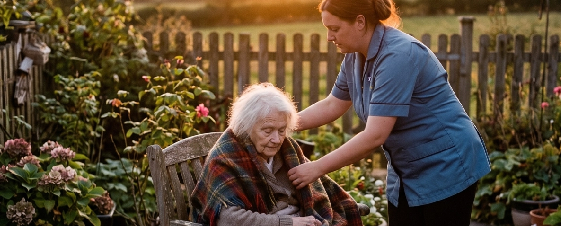
The home is one of the most powerful tools available in dementia care. Familiar surroundings, familiar objects, and familiar routines provide an anchor when internal orientation becomes unreliable. Our role is to support the person in maintaining that anchor for as long as possible.
Consistency of carer. This is non-negotiable in dementia care. An unfamiliar face arriving at the door can be distressing and disorienting. We maintain the same small team of carers for each client, introducing any changes carefully and gradually. Over time, carers become part of the familiar landscape of a person's day — a known face, a known voice, a known routine.
Routine and structure. We build visits around the individual's established daily rhythm wherever possible. The time of the morning call, the order in which tasks are completed, the words and prompts used — these become familiar and reassuring. Predictability reduces anxiety. We do not change things without reason, and when changes are necessary we introduce them gradually.
Gentle, clear communication.We are trained in communication approaches that reduce confusion and distress — speaking calmly and clearly, using the person's preferred name, avoiding complex questions, offering choices rather than open-ended decisions, and responding to the emotion behind a statement rather than its literal content. We do not contradict or correct in ways that increase distress. We meet the person where they are.
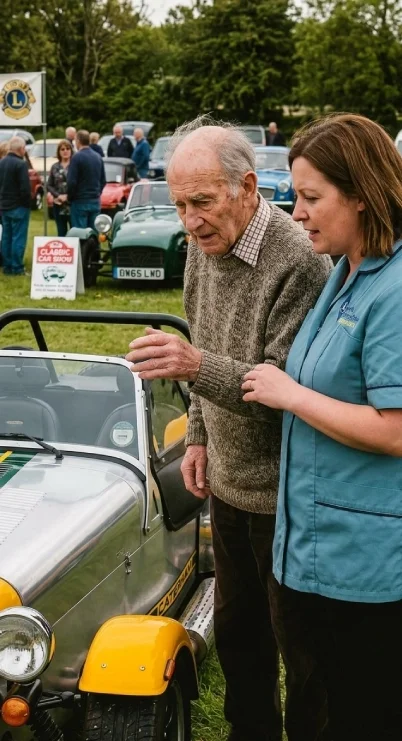
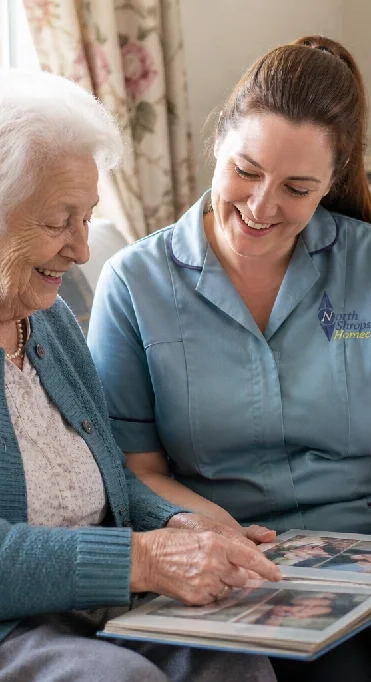
Meaningful activity and engagement. Cognitive stimulation — appropriate to the individual's current abilities and interests — is an important part of dementia care. This might be looking through photographs, listening to familiar music, tending to a garden, doing a simple puzzle, or simply having a conversation about the things a person has always loved. We learn the life story of every client we support, because knowing who someone has been informs how we care for who they are now.
Personal care delivered with patience. For someone living with dementia, personal care can sometimes feel confusing or threatening. We are experienced in approaches that make this as calm and comfortable as possible — maintaining a consistent routine, using clear verbal guidance, allowing extra time, and responding flexibly to a person's state on any given morning.
Managing the Difficult Moments
Families often come to us not at the point of diagnosis but at the point of a specific challenge — a behaviour that has become difficult to manage, a change in the person they love that has frightened them. We want to be direct about some of the things we have experience managing.
Late-day confusion— formerly known as sundowning, this is the increase in confusion, agitation, and distress that many people with dementia experience in the late afternoon and evening. We understand the triggers like fatigue, pain or discomfort, hunger or thirst, environmental triggers and disrupted internal clocks and we know the management strategies. We can discuss with families how to structure the later part of the day to reduce its severity.
Repetition and repeated questions — one of the most exhausting aspects of dementia for family carers. Our team responds to repeated questions with patience and without frustration, understanding that the person is not choosing to repeat themselves and cannot be reasoned out of it.
Resistance to care — when a person with dementia refuses personal care, medication, or other support, it is rarely simple obstruction. It usually reflects fear, discomfort, or a failure of communication. We are trained to find approaches that work — not to force, but to create the conditions in which a person feels safe enough to accept help.
Wandering and disorientation — understanding the risks associated with a person becoming disoriented within or outside the home, and how to manage the environment and the visit to reduce these risks.
Behavioural and psychological symptoms — changes in mood, personality, and behaviour are a feature of dementia that families often find the most distressing. We do not pathologise these changes. We respond to them with understanding, adapt our approach accordingly, and communicate clearly with families and the clinical team when something is changing.
Supporting Families
Dementia is a family condition. The person with the diagnosis is at the centre, but everyone around them is affected — and family carers, in particular, carry a weight that is often invisible to the outside world.
We work closely with families throughout the care relationship. This means:
Keeping you informed — communicating clearly about how visits are going, what we are observing, and when something is changing. Families who do not live locally — in Birmingham, Manchester, or further afield — rely on us to be their eyes and ears between visits. We take that responsibility seriously.
Answering your questions honestly — about what we are seeing, about what to expect as the condition progresses, and about when the level of need may be moving beyond what domiciliary care can safely provide. We will not tell you what you want to hear at the expense of what you need to know.
Supporting the transition to increased care — dementia care needs evolve, sometimes gradually and sometimes suddenly. We help families anticipate and navigate those transitions rather than arriving at crisis points unprepared.
Offering respite — giving family carers time away from the caring role, with the confidence that their relative is in safe, familiar hands. This is not a secondary benefit of our service. It is one of its core purposes.
Our Experience and Credentials
North Shropshire Homecare was founded by Maggie Allen, who brought over 25 years of specialised nursing and dementia experience to building this service. The approach to dementia care, the training standards, and the values that shape every visit were developed under her leadership over fourteen years.
Alice Allen, our soon to be Registered Manager, has been trained within this specialism and continues to develop it. All of our carers receive dementia-specific training as a core part of their induction, and ongoing training in dementia care is a condition of working with NSHC, not an optional extra.
We are registered with and inspected by the Care Quality Commission, rated Good. Our full inspection report, including specific observations about how we support people living with dementia, is available on the CQC website and we link to it from our compliance section.
Starting the Conversation
The best time to arrange dementia support is before the situation becomes urgent — while there is time to introduce carers gradually, build familiarity, and establish a routine that the person can adapt to. Many families wait until a crisis forces their hand. Where possible, we would encourage you not to wait.
If you are at the early stages of thinking about support and are not yet sure what you need, a conversation costs nothing and commits you to nothing. We can talk through the current situation, explain what we can offer, and help you understand what questions to ask the GP and the memory service.
Dementia UK is our chosen charity of 2026, read more about how we are helping here.
Call our Whitchurch office on 01948 411222 (Monday to Friday, 9am to 4pm) or email mail@nshomecare.co.uk to arrange a confidential chat or a free home assessment.
For urgent situations, our number is answered 24 hours a day, 365 days a year.
North Shropshire Homecare The Coach House, 15/17 Green End, Whitchurch, SY13 1AD
Providing specialist dementia care and support across Whitchurch, Wem, Prees, Whixall, Ash, Higher Heath, Tilstock and the surrounding villages of North Shropshire.

Dementia UK | Our Chosen Charity of the Year.
Every year we pick one cause to put real effort behind — genuine, sustained fundraising, awareness, and support. This year, that cause is Dementia UK.
Supporting the fight for Dementia UK as our Charity of 2026 is our way of putting our energy where our expertise already lives.