
Stroke Recovery Care at Home in North Shropshire
Have this page read to you
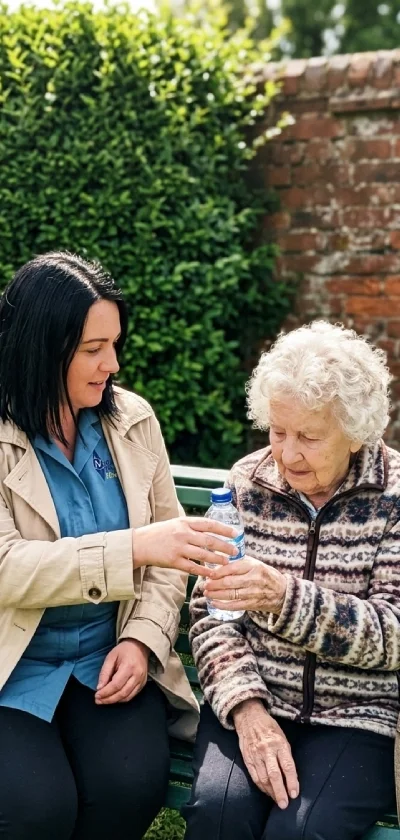
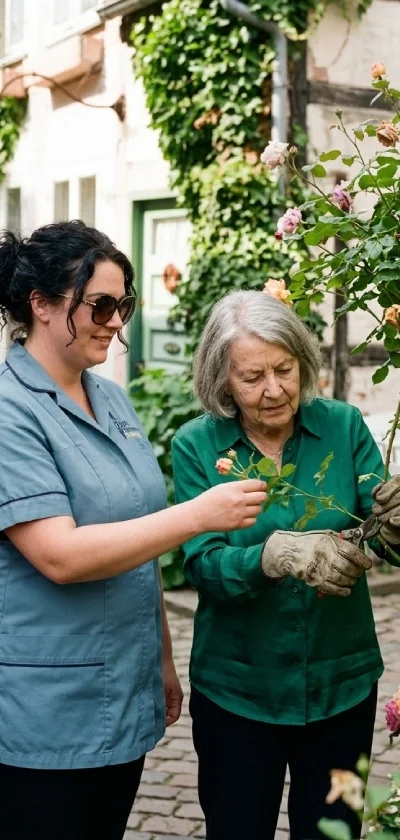
A stroke changes everything. Not gradually, not with warning, but in minutes — often seconds. A person who was independent, capable, and living a full life is suddenly in a hospital bed, facing a recovery journey that nobody told them to prepare for and that the NHS, overstretched as it is, cannot always support as fully as it should.
There are 1.4 million stroke survivors in the UK today. Around 100,000 people have a stroke every year — one every five minutes. Stroke is the leading cause of complex adult disability in the UK, and 60% of stroke survivors are left with a disability. The number of survivors is projected to rise to over 2.1 million by 2035 as the population ages and acute treatment improves.
Despite this, the post-stroke care system is under serious pressure. Only 35.1% of patients received the recommended six-month review between April 2024 and March 2025. Over 20% of stroke survivors leave hospital with severe disability. And a World Stroke Day 2025 survey found that only 19% of the public believed stroke survivors need long-term rehabilitation — a profound misunderstanding of a condition that demands exactly that.
If you or a family member has survived a stroke and has come home from hospital, this page is about what happens next. What recovery actually looks like. What professional home care can provide that accelerates and sustains it. And why getting the support right in the weeks, months, and years after a stroke is as important as the acute treatment in the hospital.
Understanding Stroke — What It Is and Why Recovery Varies So Much
A stroke occurs when the blood supply to part of the brain is cut off, either by a blood clot blocking an artery (ischaemic stroke — accounting for 85% of all cases) or by a blood vessel bursting (haemorrhagic stroke). Without blood, brain cells begin to die within minutes. The damage that results depends entirely on which part of the brain is affected and for how long.
This is why no two strokes are the same, and why no two stroke survivors have identical recovery needs. A stroke affecting the left hemisphere typically causes right-sided physical weakness and speech and language difficulties. A stroke affecting the right hemisphere typically causes left-sided physical weakness, spatial awareness problems, and personality or behavioural changes. A stroke affecting the cerebellum causes balance and coordination problems. A brainstem stroke can affect breathing, heart function, and consciousness.
The specific combination of deficits a person carries out of hospital — and the specific combination of support they need at home — is unique to them. This is why the care plan we build for every stroke survivor is built from the individual rather than from a template.
What Recovery Actually Means
The brain has a remarkable, though not unlimited, capacity for reorganisation following injury — what neurologists call neuroplasticity. In the weeks and months after a stroke, the brain can form new neural pathways that partially or fully compensate for the function lost in the damaged area. This is the biological basis of stroke rehabilitation, and it means that recovery — real, functional recovery — is genuinely possible for most stroke survivors.
But neuroplasticity has conditions. It requires repetition. It requires effort. It requires the right kind of stimulation, delivered consistently, over a sustained period. Recovery that is not actively supported tends to plateau. Recovery that is actively supported — by rehabilitation professionals, by consistent home care, by an environment that enables rather than compensates for lost function — continues for longer than many people expect.
The most intensive window for neuroplastic recovery is the first three to six months after a stroke. What happens in this window matters enormously. Support that fills the gap between hospital discharge and full independent function during this period is not a convenience — it is a clinical intervention.
The Challenges Stroke Survivors Face at Home
-
One-sided weakness or paralysis — hemiplegia — is one of the most common consequences of stroke. It affects the side of the body opposite to the affected hemisphere of the brain. For some survivors the weakness is mild; for others it is a complete loss of function in the arm and leg on one side.
At home, hemiplegia affects everything. Getting out of bed. Getting dressed. Preparing food. Walking to the bathroom. The care that supports a person with hemiplegia is not simply about doing tasks for them — it is about doing them in a way that supports the neurological recovery process. Carers who always do everything for a hemiplegic person slow recovery. Carers who support active participation in every task, consistently, with the right technique and the right equipment, support it.
-
Aphasia — difficulty with speaking, understanding language, reading, and writing — affects around one in three stroke survivors. It is caused by damage to the language-dominant hemisphere of the brain (usually the left) and has nothing to do with intelligence or cognitive function. A person with aphasia understands what is being said to them and has thoughts they want to express. The difficulty is in the mechanics of language itself.
Aphasia can be one of the most isolating consequences of stroke. A person who was articulate, confident, and socially connected may find themselves unable to produce the words they intend. The frustration and loss this causes are profound.
Carers who do not understand aphasia communicate in ways that make it worse — finishing sentences, talking over the person, treating slow or unclear speech as cognitive impairment. Carers who understand it create the conditions for communication — patience, processing time, clear and simple language, alternative communication methods, and the consistent reassurance that the person is being heard.
-
Swallowing difficulties affect up to 65% of stroke survivors in the acute phase. For many people they resolve within weeks. For others they persist and require careful ongoing management.
Aspiration — food or liquid entering the airway rather than the oesophagus — is the primary risk of dysphagia, and aspiration pneumonia is a serious and potentially life-threatening complication. Many stroke survivors are discharged home with specific guidance from a Speech and Language Therapist (SALT) on food textures and fluid consistencies.
This guidance is not optional. It is a clinical prescription, and implementing it correctly at every mealtime is one of the most important things a home carer provides for a stroke survivor with dysphagia.
-
Post-stroke fatigue is experienced by up to 85% of stroke survivors and is one of the least understood and most underestimated consequences of stroke. It is not ordinary tiredness. It is a profound, disproportionate exhaustion that can occur after minimal physical or cognitive activity, bears no reliable relationship to how much a person has done, and does not reliably resolve with sleep or rest.
The neurological explanation is that a damaged brain has to work significantly harder to achieve the same result as an undamaged one. The cognitive and physical effort of managing a stroke-affected body through a normal day consumes resources that previously lasted all day.
Post-stroke fatigue can be the difference between a good recovery day and a difficult one. It can fluctuate significantly from week to week. And it is frequently dismissed — by people around the stroke survivor, sometimes by healthcare professionals, and sometimes by the stroke survivor themselves who may push through it and pay a significant neurological price for doing so.
-
Depression affects approximately one in three stroke survivors, and anxiety is similarly common. These are not simply reactions to changed circumstances. They have neurobiological causes — stroke damage can directly affect the brain circuits involved in mood regulation, and the neurochemical changes that follow a stroke contribute directly to depression independent of the psychological impact of the event.
Post-stroke depression profoundly affects recovery motivation, social engagement, and quality of life. It is one of the strongest predictors of poor long-term outcomes after stroke. It requires recognition and proper treatment — not cheerful encouragement from carers who do not understand what they are observing.
Emotionalism — involuntary crying or, less commonly, laughing, triggered by things that would not normally provoke such a response — is also common after stroke and can be distressing for the stroke survivor and their family. It reflects neurological changes rather than the emotional state the survivor is actually in.
-
Memory, attention, processing speed, and executive function can all be affected by stroke, depending on the area of the brain involved. These changes range from mild — noticeable but manageable — to significant, and they can affect every aspect of daily life and rehabilitation.
Vascular cognitive impairment, caused by the disruption to blood supply that produced the stroke, is distinct from Alzheimer's-type dementia and may present differently. In some stroke survivors, cognitive difficulties improve substantially with time and rehabilitation. In others, particularly those with multiple small strokes (multi-infarct dementia), they progress.
-
Hemianopia — loss of the visual field on one side — affects around a quarter of stroke survivors. It can cause significant difficulties with navigation, reading, driving, and safety awareness. Carers need to know which side is affected, how to approach the person, and how to arrange the environment to compensate for the field defect.
-
Bladder and bowel problems affect many stroke survivors, particularly in the early phase. Urinary incontinence, urgency, and retention are common. Most resolve with time and appropriate management, but require careful, dignified support in the interim.
How We Support Stroke Recovery — In Detail
Supporting Active Rehabilitation — Not Just Completing Tasks
This is the most important principle in stroke recovery home care, and the one most frequently misunderstood.
Recovery from stroke requires the brain to practise the functions it has lost. This means that a stroke survivor who is dressed by their carer every morning is not recovering dressing function — they are being maintained. A stroke survivor who is encouraged and supported to participate in dressing — even when it takes three times as long, even when it is imperfect, even when the carer could do it faster alone — is giving their brain the repetitive practice that drives neuroplastic recovery.
Our carers understand this distinction. We do not complete tasks for stroke survivors when those survivors can participate, even partially. We support active participation in every task, at every level of current function, using the techniques recommended by the physiotherapist and occupational therapist involved in the person's care.
This requires patience. It requires a willingness to take twice as long. It requires genuine understanding of why it matters, not just instruction to do it. We train for this specifically, because the instinct to help — to do it for someone — is exactly what good stroke recovery care must resist.
Personal Care
Personal care for stroke survivors combines the technical requirements of supporting physical weakness with the psychological sensitivity of supporting a person who may be grieving their former independence.
For hemiplegic clients — personal care approach differs significantly depending on the side and degree of weakness. Washing the affected arm and hand requires specific technique to avoid damage to a shoulder joint that may be at risk of subluxation (partial dislocation). Dressing follows a specific sequence — affected limb first when dressing, affected limb last when undressing — that reduces the difficulty and discomfort of managing clothing around a weaker side.
Bathing and showering requires careful environmental adaptation — grab rails, shower seats, non-slip surfaces, appropriate water temperature — and an approach that balances safety with dignity and the encouragement of independence. We work closely with the occupational therapist to ensure the bathroom environment is optimised for the person's specific functional profile and reviewed as that profile changes.
Oral hygiene may require adaptation for a stroke survivor with facial weakness or a hemiplegic arm. We implement any specific recommendations from the SALT team and are alert to the dental health implications of reduced oral care capability.
Communication Support
We are trained to communicate effectively with stroke survivors with aphasia:
We allow time. A person with aphasia may take significantly longer to produce a response than a person without. We do not finish their sentences. We do not fill the silence with our own words. We wait, genuinely, for the person to communicate in whatever time it takes.
We use clear, simple language. Short sentences. One idea at a time. We check understanding rather than assuming it.
We support alternative communication. Many stroke survivors with aphasia use communication books, apps, or gesture systems. We learn the specific system in place for each client and use it naturally rather than treating it as a last resort.
We never conflate aphasia with cognitive impairment. A person with aphasia is not confused, unintelligent, or incapable of making decisions. They are a person with a specific language processing difficulty. Our carers understand this and communicate accordingly.
Mealtime Support and Dysphagia Management
For stroke survivors with swallowing difficulties, mealtime support is a clinical task as much as a practical one.
We implement SALT guidance precisely. Thickened fluids at the correct consistency — syrup thick, custard thick, or pudding thick — prepared correctly and consistently. Food textures at the prescribed level. We do not improvise around SALT recommendations and we do not reduce consistency standards because a client finds them unpleasant. We flag to the clinical team if a client is refusing prescribed texture modifications, because this is a patient safety issue.
We position correctly for eating. Upright, supported, with the head in the correct position for safe swallowing. We allow adequate time for each mouthful. We are alert to the signs of aspiration — coughing during or after swallowing, a wet or gurgling voice quality after eating, unexplained recurrent chest infections — and we communicate these observations promptly.
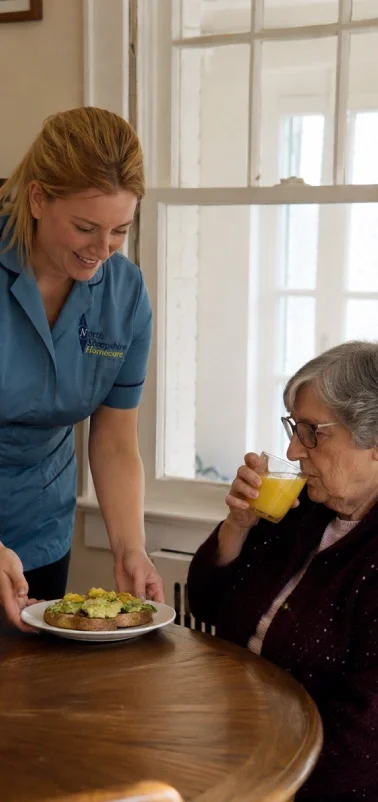
We support nutritional recovery. Post-stroke appetite is often reduced, and adequate nutrition directly affects recovery. We prepare food that is nutritious, appealing, and appropriate to any texture requirements. We monitor food and fluid intake and flag concerns about poor intake to the family and clinical team.
For stroke survivors using a PEG tube — where stroke has produced swallowing difficulties severe enough to require tube feeding — we provide full PEG feeding support with client-specific training from the clinical nutrition team before the first visit.
Medication Management
Stroke medication regimens are typically significant and non-negotiable in their timing. Anticoagulants, antihypertensives, antiplatelets, and disease-modifying medications must be taken consistently, at the right times, without gaps.
We manage medication for stroke survivors using our eMAR system — real-time documentation of every dose, every interaction, every refusal. We monitor for the specific medication interactions and side effects that are relevant to stroke medication regimens and communicate any concerns promptly to the GP.
We are also alert to the medication compliance challenges that cognitive changes after stroke can create — a stroke survivor who has forgotten they have already taken their medication, or who cannot reliably read the labels, or who is confused about their regimen — and we document and manage these situations explicitly rather than assuming compliance.
Moving, Handling, and Transfers
Safe moving and handling for stroke survivors requires knowledge of hemiplegic technique — the specific approach to transfers, repositioning, and mobility support that is appropriate for one-sided weakness.
This includes correct hoist technique where required, the specific shoulder protection required for a hemiplegic arm during any transfer, the use of slide sheets and transfer boards for lateral transfers, and the approach to supported walking that encourages neurological recovery while maintaining safety.
We implement the specific guidance of the physiotherapy team for each client's current mobility level and we review our approach as that level changes. We document falls and near-misses specifically and communicate them to the clinical team, because a pattern of falls after stroke almost always has a modifiable cause.
Emotional Support and Companionship
Post-stroke depression affects one in three stroke survivors and is one of the strongest predictors of poor long-term outcomes. A carer who recognises and responds appropriately to low mood — who does not dismiss it, does not try to argue the person out of it with positive thinking, and who documents persistent low mood for the GP — is making a genuine contribution to recovery.
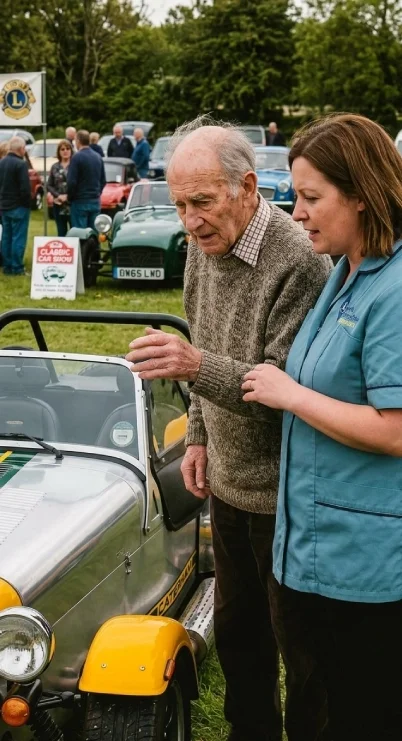
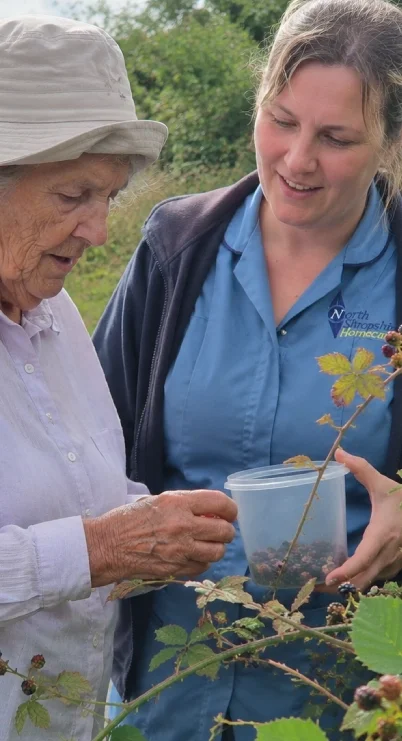
We are also the consistent daily presence that keeps a stroke survivor connected to their life. Conversation — adapted to aphasia or cognitive changes where present, but genuine conversation with a person who is interested in them — matters. Time outside. Music. Looking at photographs. Staying connected to the things that the stroke has not taken away.
For many stroke survivors, the greatest loss is not function but identity — the sense of being a person with a history and a personality and things that matter to them, rather than a patient with deficits. Care that keeps that identity visible, that treats the person as someone rather than something, is the care that supports the best outcomes.
Supporting the Family Carer
Caring for a stroke survivor is one of the most demanding care giving roles there is. The physical demands are significant — moving, handling, personal care, mealtime support. The emotional demands are profound — grief for the person who existed before the stroke, anxiety about the future, exhaustion from a role that never fully stops.
Research consistently shows that family carers of stroke survivors have significantly elevated rates of depression, anxiety, and physical health problems. The burnout that comes from sustained care giving without support has a well-documented trajectory.
We provide regular scheduled support, sitting services, and overnight cover that gives family carers genuine rest — not time spent in the next room listening, but real time away, with confidence that the person they love is with someone trained, attentive, and genuinely engaged.
This is not a secondary service for stroke care. It is among the most important things we do.
The First 72 Hours at Home After Stroke — Getting It Right
The transition from hospital to home is one of the highest-risk moments in the stroke recovery journey. A stroke survivor who has been on a ward with immediate clinical support returns to a home environment that may not yet be adapted, to a family who may not be trained, and to a care package that may not yet be fully in place.
We have written a full guide to the first 72 hours of arranging home care — what happens from the moment you call us to the first care visit — which is available on our blog. For stroke specifically:
Call us before discharge day if possible. The ward team and discharge coordinator can provide clinical information that will shape the care plan. We can often begin care the same day as discharge if needed.
Tell us about the OT, SALT, and physio recommendations. Every recommendation made by hospital therapy staff needs to be implemented at home, consistently, from day one. We need to know what those recommendations are.
Check the home environment before the person returns. We carry out an enhanced environmental check on the first post-discharge visit, but anything that can be done in advance — removing trip hazards, arranging grab rails, setting up the bed position — reduces risk on the most challenging day.
Expect the first week to be hard. The gap between the support level of a hospital ward and the support level of even a well-run care package is significant. The first week at home after stroke is consistently identified as one of the highest-risk periods for readmission. Consistent care visits, attentive monitoring, and prompt escalation of any clinical concern during this period significantly reduce that risk.
Working With the NHS Stroke Team
Stroke recovery is multidisciplinary, and our role is to connect the work of the specialist team to the reality of daily life at home.
The integrated community stroke service (ICSS) — the NHS model for coordinating post-hospital stroke rehabilitation — provides early supported discharge, community stroke rehabilitation, and six-month reviews. We work alongside these services, implementing physiotherapy programmes, SALT guidance, and OT recommendations in the daily care routine.
We communicate clinical observations to the relevant team members promptly and specifically. Changes in speech, new neurological symptoms, falls, signs of aspiration, mood changes, medication concerns — all of these are documented and communicated rather than noted and filed.
Only 35.1% of stroke survivors are currently receiving their recommended six-month review. The NHS stroke team is stretched. A care team that documents well, communicates clearly, and flags clinical concerns promptly extends the reach of overstretched specialist services into the daily life of the person who needs them.
Why Home Is Usually the Right Place for Stroke Recovery
The evidence on stroke recovery at home is unambiguous: for most stroke survivors, early supported discharge to home — with the right care package — produces better outcomes than prolonged hospital stay or residential placement.
Home provides the environment that stroke recovery requires: familiar surroundings that provide cognitive and spatial orientation, the motivation of meaningful goals and real life, the social connections that drive recovery, and the opportunity for the kind of purposeful activity that stimulates neuroplastic recovery in a way that a hospital or care home environment rarely matches.
In North Shropshire, in the homes and villages we have been serving for fourteen years, we make this possible. We know the area, we know the families, and we know what good stroke recovery support looks like — not from a textbook, but from the daily experience of providing it.
Arrange a Free Home Assessment
If you or someone you love has had a stroke and needs support at home in North Shropshire — whether immediately following discharge, during ongoing recovery, or managing longer-term stroke-related disability — we would be glad to talk.
A free home assessment costs nothing and commits you to nothing. We visit, we listen, and we give you an honest picture of what we can provide and how quickly we can begin.
📞 01948 411222 — 24 hours, 365 days
✉️ mail@nshomecare.co.uk
North Shropshire Homecare
The Coach House, 15/17 Green End, Whitchurch, SY13 1AD
Providing specialist stroke recovery care at home across Whitchurch, Wem, Prees, Whixall, Higher Heath, Tilstock, Ash, and the surrounding villages of North Shropshire. CQC Rated Good. Independently Owned. Locally Staffed.
-
The information on this page has been checked for clinical accuracy and aligns with current best practices for care at home for Stroke Recovery.
Next review July 2027.
Tailored to you.
Before we start caring for you, we will make a bespoke care plan suited just to your needs. We believe in person-centred care and we will keep you involved with this process so you have full control of your care. We will arrange to do an assessment with you and anyone else you want involved in your care plan to make sure you are satisfied with how your care will be carried out.