
Physical Disability & Promoting Independence
Have this page read to you
If you are reading this page, something has probably changed.
Perhaps it changed suddenly — a stroke, a fall, a diagnosis that arrived without warning and rearranged what the future looks like.
Perhaps it has been changing gradually, a condition progressing over months or years until the gap between what you want to do and what your body allows has become impossible to ignore. Perhaps you have lived with a physical disability for a long time and what has changed is simply your circumstances — a move, a bereavement, a support network that is no longer what it was.
Whatever has brought you here, the question underneath it is the same: how do I continue to live the life I want, in my own home, on my own terms?
That is the question we are here to help answer.
Our Starting Point
At North Shropshire Homecare, we do not approach physical disability support as a list of tasks to complete on someone's behalf. We approach it as a partnership — between us, the individual, and the people around them — built around a single consistent goal: maximum independence, maintained for as long as possible, in the way that matters most to that person.
This means our starting point is always what someone can do, not what they cannot. It means we do not take over where we are not needed. It means we adapt our support as a person's situation changes — scaling up when things are harder, scaling back when they improve — rather than applying a fixed care package that stops reflecting reality.
And it means we invest in knowing the person: their history, their priorities, the things that define their daily life and that they are not willing to lose.
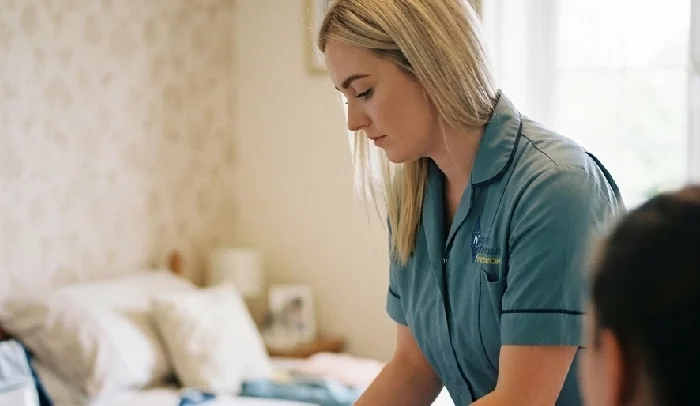
“People we spoke with told us that they felt safe being supported at home by the staff. A family member told us, “We never have any worries ever. [Person’s name] is amazingly safe with them (staff); they are so caring and safety is at the forefront of everything that they do.”
The Conditions We Support
Our team has experience supporting individuals living with a wide range of physical conditions and disabilities, including:
Stroke and acquired brain injury
supporting recovery and adaptation following stroke, including one-sided weakness or paralysis, speech and swallowing difficulties, fatigue, and the cognitive changes that can accompany brain injury. We understand that stroke recovery is rarely linear and that the person adjusting to post-stroke life is navigating a profound change in their sense of themselves, not just their physical capability.
Multiple Sclerosis
Supporting individuals through the fluctuating nature of MS, adapting to periods of relapse and remission, and providing consistent support that accommodates the variability of a condition that can change significantly from day to day.
Parkinson's disease
Understanding the specific challenges of Parkinson's including tremor, rigidity, slowness of movement, and the particular difficulties around personal care, mealtimes, and medication timing. We are experienced in the communication and pacing approaches that make support work well for someone living with Parkinson's.
Spinal cord injury
Providing personal care, moving and handling, and daily living support for individuals with paraplegia or tetraplegia, with the precision and training that high-level spinal injury requires.
Cerebral palsy and lifelong physical disability
Supporting individuals who have lived with their condition throughout their lives and who know precisely what they need and how they need it. For this group in particular, our role is to follow the individual's lead completely — they are the expert in their own care.
Acquired limb loss
Supporting individuals adapting to limb amputation, including assistance with prosthetics, daily care, and maintaining the activity and independence that recovery requires.
Progressive neurological conditions
Including Motor Neurone Disease, Huntington's disease, and other conditions where the trajectory of care needs is known and planning ahead is both possible and important.
This list is not exhaustive. If a condition you are living with is not named here, please call us. The question is always whether we have the training, the experience, and the capacity to support that person safely and well — and we will answer it honestly.
-
» Read our detailed page on Stroke Care in Shropshire Here «
» Read our detailed page on Multiple Sclerosis Care in Shropshire Here «
» Read our detailed page on Parkinson's Disease Care in Shropshire «
» Read our detailed page on Spinal Cord injury Care in Shropshire «
» Read our detailed page on Huntington’s Disease Care in Shropshire «
» Read our detailed page on Motor Neurone Disease Care in Shropshire «
Moving and Handling — Done Properly
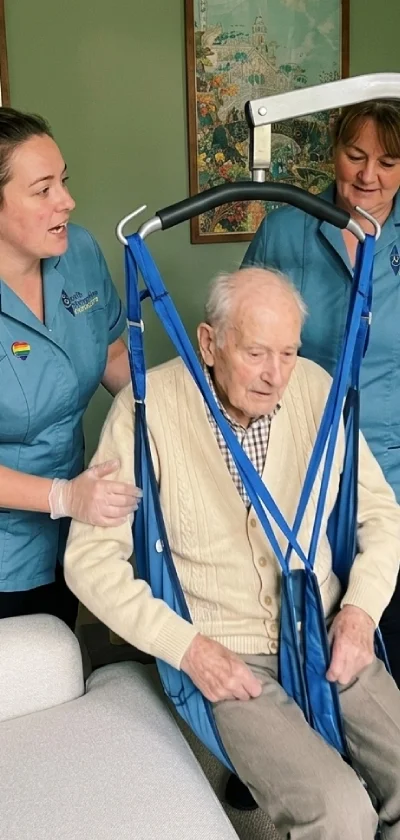
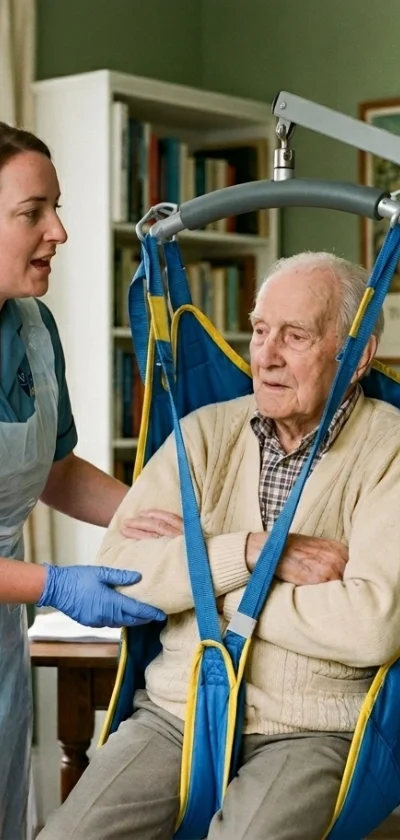
Safe, skilled moving and handling is the foundation of physical disability care. Done well, it protects the individual from injury, preserves their dignity, and makes every transition — from bed to chair, from chair to bathroom, from ground floor to first floor — feel managed rather than precarious. Done poorly, it is a source of falls, pressure injuries, and the particular humiliation of being moved roughly or carelessly.
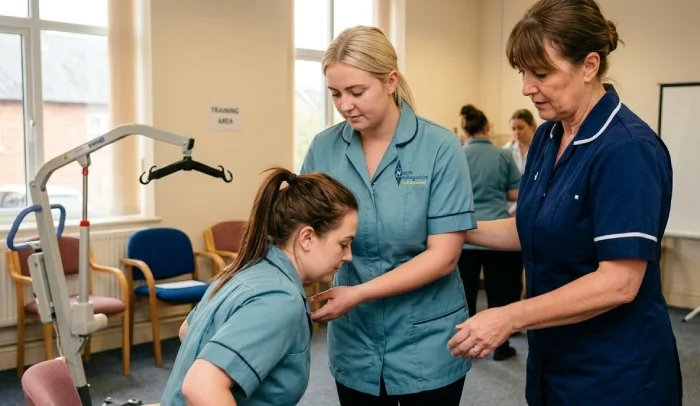
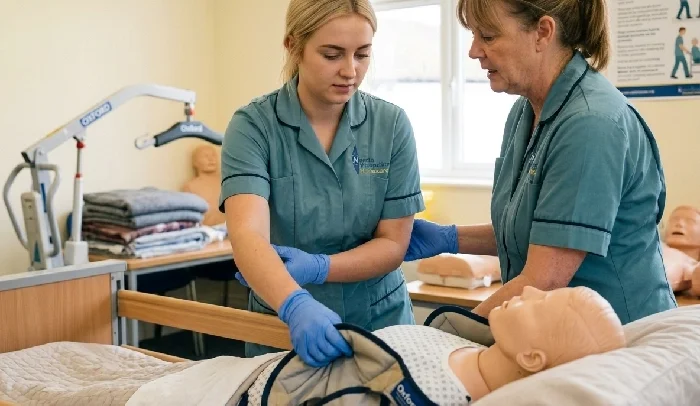
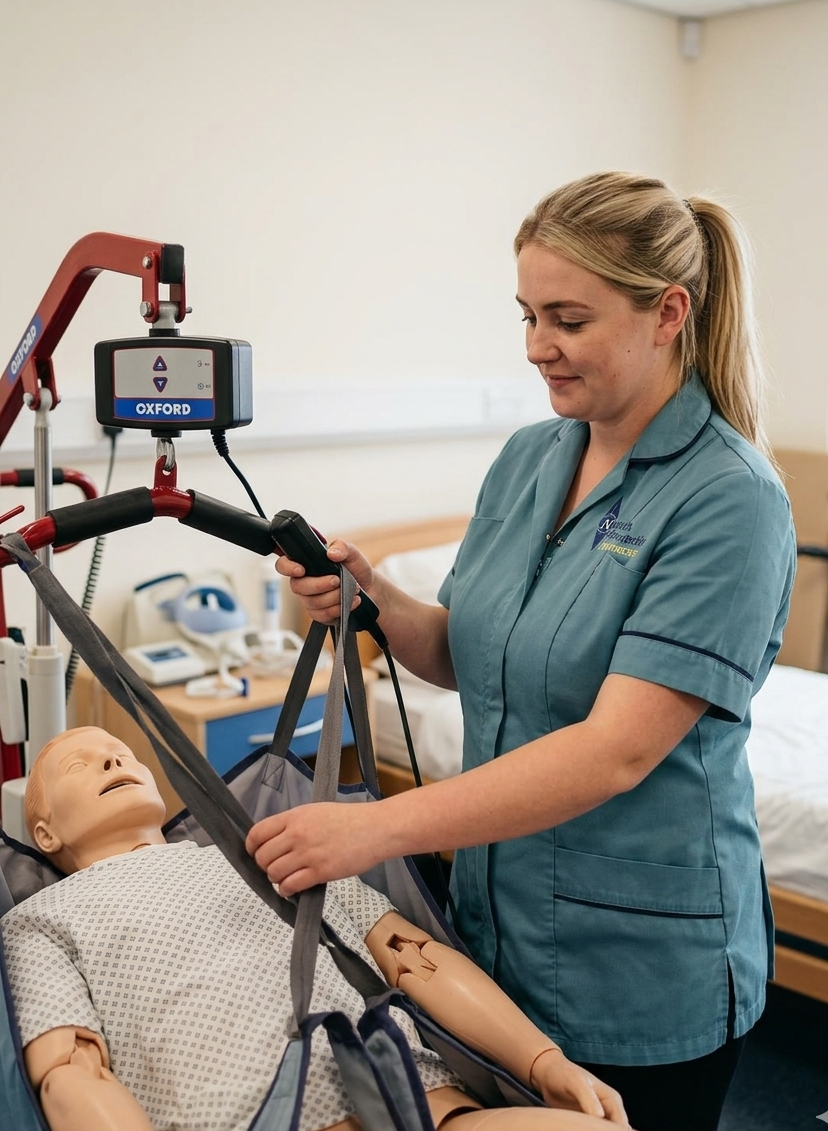
Hoist operation — ceiling track hoists, mobile hoists, and standing hoists, used correctly and with full attention to sling fit, positioning, and the comfort and dignity of the person being transferred. We do not rush hoist transfers. The time it takes to do them properly is the time it takes.
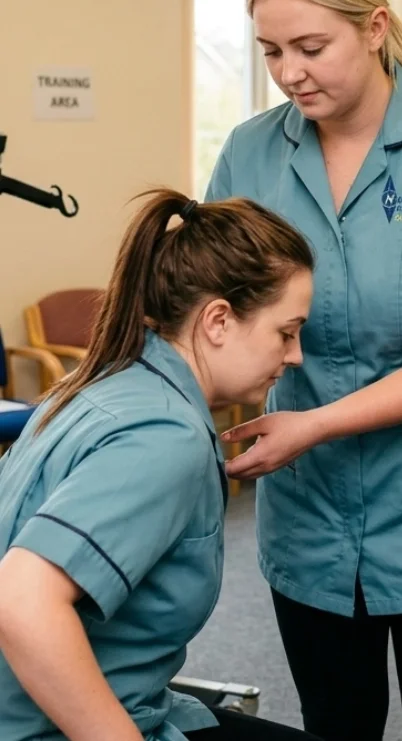
Stand-aids and transfer boards — for individuals who retain some weight-bearing ability and for whom a full hoist transfer is not always necessary. We assess which approach is right for each transfer and each day, because a person's ability to bear weight can change from morning to evening.
Slide sheets and repositioning aids — for safe repositioning in bed, pressure area care, and managing the transitions that happen before the day's main transfers.
Profiling beds and specialist mattresses — understanding how to use and adjust profiling beds to support safe repositioning, pressure relief, and the comfort of someone spending extended time in bed.
Stairlifts, ramps, and access equipment — supporting safe use of mobility aids within the home environment and flagging when equipment is not functioning correctly or is no longer appropriate for a person's needs.
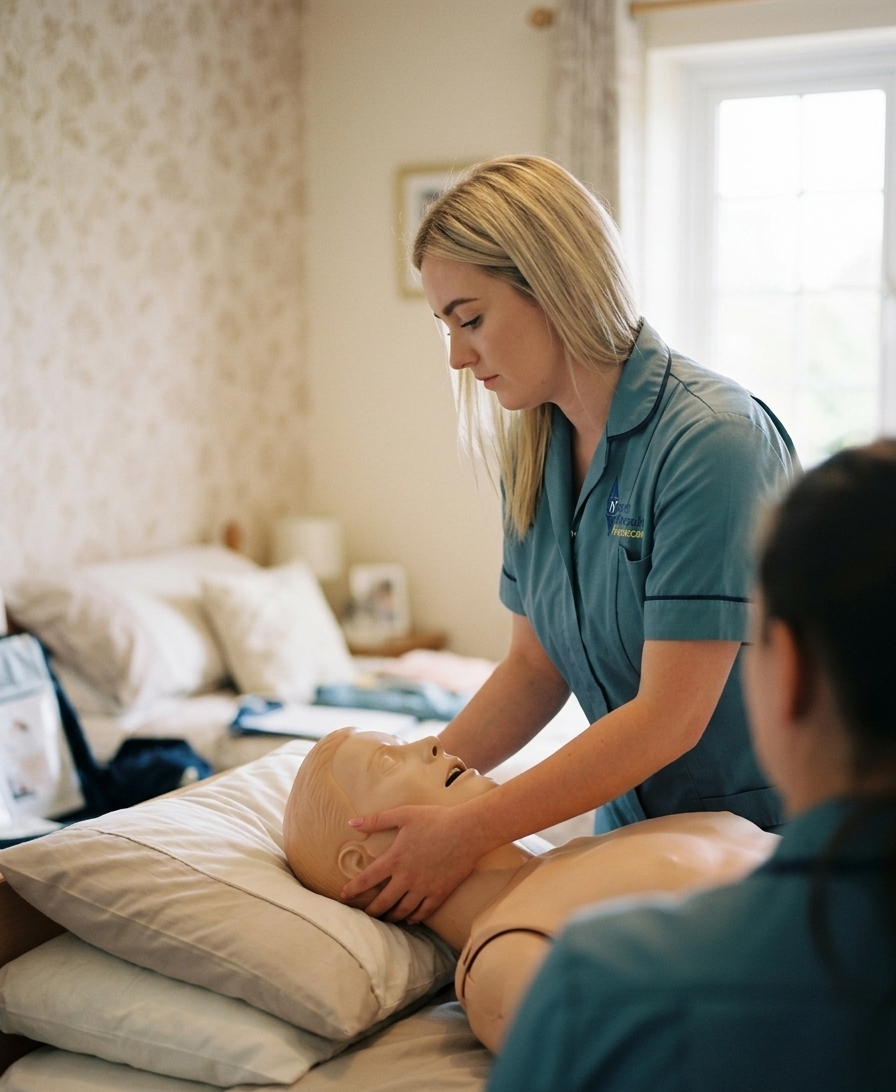
We do not use equipment we have not been trained on. If a client's needs involve specialist equipment that requires specific training, we arrange that training before the first visit. We will never send a carer into a situation they are not prepared for.
Advisory Support and Home Adaptations
A well-adapted home is one of the most powerful enablers of independence available to someone with a physical disability. The right grab rail in the right place, a wet room instead of a bath, a ramp at the front door — these changes can be the difference between managing independently and not managing at all.
We are not occupational therapists, and we are clear about that. The formal assessment and prescription of adaptations is an OT's role, and we actively support families in accessing that assessment. What we offer alongside it is the informed practical perspective of a team that works in people's homes every day — noticing what is working, what isn't, and what a small change might improve.
Environmental observation — during every visit, our carers observe the home environment with safety and independence in mind. A loose stair carpet, a threshold that has become a trip hazard, a bathroom layout that is increasingly difficult to navigate safely — these are noted and raised with the family and the office.
Equipment guidance — advising on the range of daily living aids that can make a meaningful difference: perching stools, long-handled tools, bath boards, raised toilet seats, non-slip mats, tap turners, and the many small adaptations that preserve independence in the specific tasks that matter most to an individual.
Occupational Therapy liaison — supporting families in making the case for OT assessment and referral, and in communicating clearly with OTs and equipment providers about what is actually needed in a specific home. We cover the full North Shropshire area including the more rural communities of Whixall, Tilstock, Ash, and Higher Heath, and we are experienced in navigating the access challenges that rural locations sometimes present for equipment delivery and installation.
Longer-term planning — where a condition is progressive, helping families think ahead about adaptations that will be needed in six months or two years, so that changes can be planned and funded rather than arranged in crisis.
The Emotional Dimension
We want to say something that service pages rarely say.
Adapting to a physical disability — whether it arrived suddenly or has been accumulating over time — is not only a practical challenge. It is a profound adjustment to identity. The person who ran a farm, built a business, raised a family, and managed their own life completely independently does not become a different person when they need help getting dressed in the morning. But they may feel like one, at least at first.
We understand this. We do not treat the practical tasks as separate from the emotional reality of what it means to need them. Our carers are trained to work in a way that preserves agency and dignity at every point — doing with rather than doing for, following the individual's lead on pace and preference, and treating the expertise a person has in their own condition and their own life with genuine respect.
The goal is never dependency. It is the confident, supported independence of a person who knows exactly what help they need and receives it in exactly the way they want it.
Talk to Us
If you or someone you love is navigating life with a physical disability and would benefit from support, we would be glad to talk through what is possible.
Call our Whitchurch office on 01948 411222 (Monday to Friday, 9am to 4pm) or email mail@nshomecare.co.uk to arrange a confidential chat or a free home assessment. There is no obligation and no pressure — just a straightforward conversation about what would actually help.
For urgent situations, our number is answered 24 hours a day, 365 days a year.
North Shropshire Homecare The Coach House, 15/17 Green End, Whitchurch, SY13 1AD
Providing the gold standard of physical disability support across Whitchurch, Wem, Higher Heath, Prees, Whixall, Tilstock, Ash, and the surrounding villages of North Shropshire.
We are the Gold Standard.
Exceptional support begins with listening. Before we ever step through your door, we work closely with you to design a fully bespoke care plan tailored to your exact needs, routines, and lifestyle.
We champion true person-centred care, ensuring you remain firmly in control of the entire process from day one. By arranging a comprehensive, relaxed assessment with you and anyone you choose to involve—whether that is family, friends, or advocates—we guarantee that every detail is perfectly aligned with your wishes. With us, your care is always delivered exactly how you want it, on your terms.