
What Happens When We Can't Help — and Who Can
There is a question that families sometimes hesitate to ask a care provider, because they worry it might sound rude. It goes something like this: "What exactly are you not able to do?"
It is one of the most sensible questions you can ask, and we want to answer it properly.
At North Shropshire Homecare, we are proud of what our team can do. But we are equally proud of knowing where our role ends and someone else's begins. Understanding that boundary isn't a limitation — it's the foundation of safe, joined-up care. A family that knows exactly who to call, and when, is a family that never wastes a precious hour calling the wrong person in a crisis.
So here, as plainly as we can put it, is the map.

What North Shropshire Homecare Does
Our carers visit clients in their own homes across Whitchurch, Wem, and the surrounding villages. Within those visits, we can help with:
Personal care — washing, dressing, grooming, and supporting dignity in the most private moments of a person's day.
Medication — prompting, assisting with, and in some cases administering medication as specified in a care plan. Crucially, we work strictly within what has been prescribed and documented. We do not make medication decisions; we carry them out safely.
Meal preparation — planning and preparing nutritious meals, with attention to dietary needs, swallowing difficulties, and hydration.
Light housework and shopping— maintaining a safe and comfortable home environment, and ensuring the fridge has something worth eating in it.
Companionship — being genuinely present. Talking, listening, sharing an activity, noticing when something feels different about a person's mood or energy.
Complex care — for clients with higher clinical needs, including support with specialist equipment such as hoists, PEG feeds, catheters, and ventilators, provided our carers have received the specific training for that client's needs.
Security calls — regular check-in visits or calls, particularly for clients living alone, to provide reassurance and catch any early signs that something isn't right.
What runs through all of these is this: we are in the business of supporting people to live well in their own homes and their own communities. Everything we do is oriented around that goal.

What Requires a District Nurse
District nurses are qualified healthcare professionals employed by the NHS who visit patients at home to provide clinical care that falls outside our scope. If you aren't already in contact with your local district nursing team, your GP can arrange a referral.
You should contact the district nursing team — not us — when someone needs:
Wound care — dressing changes for surgical wounds, pressure sores, leg ulcers, or any break in the skin that requires clinical assessment. Our carers can notice and report a wound; they cannot treat it.
Catheter care — insertion, removal, or management of urinary catheters. We can support clients who have an existing, stable catheter as part of a agreed care plan, but clinical catheter management is a nursing task.
Injections — insulin administration, anticoagulant injections (such as those given after surgery), and any other injectable medication. This is outside the scope of domiciliary care workers.
Clinical assessment — if you are uncertain whether a change in someone's condition is medically significant, a district nurse can assess in a way that we cannot.
If you are already receiving district nursing support alongside our care, the best thing we can do — and something we actively do — is communicate. If we notice something on a morning visit that the district nurse needs to know, we will make that call.
What Requires a GP
Your GP is the gatekeeper to the wider NHS system and should be your first call for anything that requires a medical decision. This includes:
Changes in prescribed medication — if a client's medication doesn't seem to be working, is causing side effects, or needs reviewing, that conversation happens with the GP. We can document and report what we observe; we cannot alter a prescription.
New or worsening symptoms — a persistent cough, unexplained weight loss, increasing confusion, changes in mobility that aren't explained by an existing condition. These need medical eyes, not care eyes.
Mental health concerns — if you are worried about depression, anxiety, significant cognitive change, or anything that suggests a person's mental wellbeing is deteriorating, the GP is the starting point for assessment and referral.
Continence issues — new or worsening bladder or bowel problems often have treatable causes and should always be assessed rather than quietly managed around.
Referrals — to physiotherapy, occupational therapy, memory clinics, palliative care teams, social services, and any other specialist service. These pathways almost always run through the GP.
One gentle but important note: GPs are busy, and it can feel easier to mention a concern to a carer than to make an appointment. We will always take those concerns seriously and encourage families to follow them up medically. But please do follow them up. We are not a substitute for a clinical assessment, and we would never want to be the reason a medical issue went unnoticed.

What Requires 111
NHS 111 is for urgent medical concerns that cannot wait for a GP appointment but are not a life-threatening emergency. Call 111 when:
A person has a new symptom that is worrying but not immediately dangerous — sudden confusion in someone without dementia, a suspected UTI, an unexpected fall with no obvious injury, chest discomfort that doesn't feel like a heart attack but doesn't feel right.
You need urgent advice outside of GP hours — evenings, weekends, bank holidays.
You are not sure whether something warrants 999 and need clinical guidance quickly.
111 can also arrange an emergency GP appointment or dispatch a clinician if needed. It is a genuinely useful service that families often underuse.
What Requires 999
Call 999 immediately — do not call us first, do not call 111 first — if someone is experiencing:
Chest pain or suspected heart attack
Signs of stroke (face drooping, arm weakness, speech difficulty — use the FAST test)
Serious fall with suspected fracture, head injury, or loss of consciousness
Severe difficulty breathing
Anaphylaxis or severe allergic reaction
Unresponsiveness or collapse
Active medical emergency of any kind
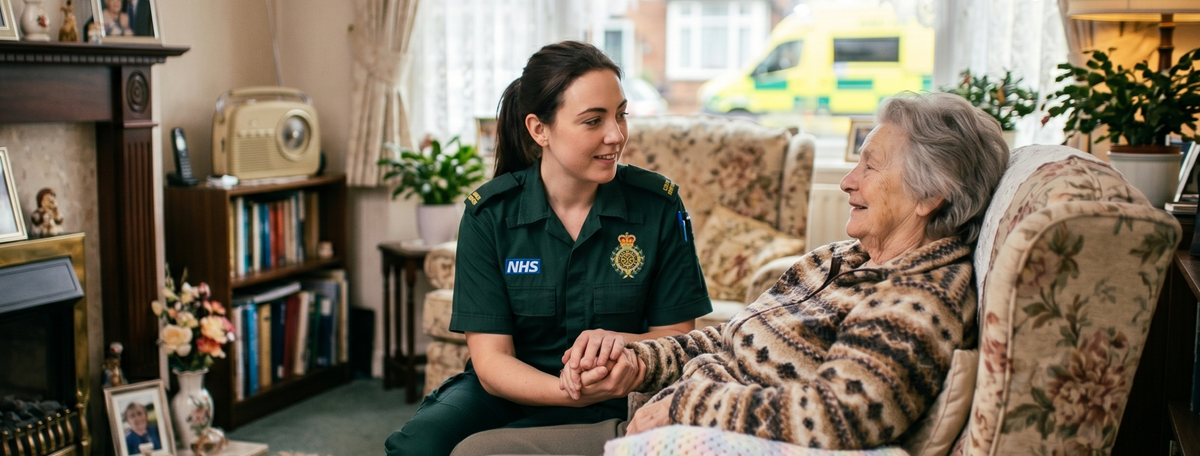
If one of our carers is present during an emergency, they will call 999 immediately and administer first aid within their training while waiting for the ambulance. They will stay with the client and contact our office as soon as the situation is stable.
What Requires Social Services
Adult Social Care, accessed through Shropshire Council, is the body responsible for assessing care needs and, where eligible, funding care packages. They are relevant when:
A person's needs have changed significantly and an existing care plan needs reassessing.
A family is struggling to fund care privately and wants to understand what the council can contribute.
There are safeguarding concerns — if anyone, carer or family member, suspects that an older or vulnerable person is being abused, neglected, or exploited, Adult Social Care should be contacted alongside the police if necessary. This is a legal and moral duty that overrides every other consideration.
A person is being discharged from hospital and needs a care package arranging — the hospital discharge team and social services work together on this, and we often work alongside both.
Shropshire Council's Adult Social Care number is 0345 678 9044.
What Requires a Residential or Nursing Home
This is the conversation nobody wants to have, but the most honest care providers have it anyway.
Domiciliary homecare — the kind we provide — is built for people who can, with support, live safely and well in their own home. There are situations where that is no longer possible, and recognising them clearly is an act of care, not defeat.
It may be time to consider residential or nursing home care when:
A person requires 24-hour nursing supervision that cannot safely be provided through visiting care.
The level of overnight need is such that a live-in carer would be required but the home environment cannot accommodate that safely.
Advanced dementia has progressed to a point where the risks of living alone — even with multiple daily visits — outweigh the benefits.
A person consistently expresses that they feel unsafe or frightened at home, even with full care support in place.
We do not make this assessment. That is the role of the GP, the social worker, and the family together. But if you ask us honestly what we are observing, we will tell you honestly what we see — because that is what you deserve from a care provider.
If and when that conversation arises, we will help navigate it. We can provide information, we can support the transition, and we can make sure the person at the centre of it all feels respected throughout.
Our Out-of-Hours Line
One final, practical point. If something happens outside of our office hours — Monday to Friday, 9am to 4pm — and it isn't a 999 or 111 situation but it does involve one of our clients or a care visit, our out-of-hours line is available 24 hours a day, 365 days a year on 01948 411222. The same number, always answered.
We are here for the things that fall within our reach. And for the things that don't, we will always help you find who is.
North Shropshire Homecare The Coach House, 15/17 Green End, Whitchurch, SY13 1AD Tel: 01948 411222 | mail@nshomecare.co.uk
Looking for more useful local services? we have a Local Services & Community Directory