
A Salute to Our Seniors: Honouring Veterans on Armed Forces Day in North Shropshire
On Saturday 27 June, flags will be flying across North Shropshire for Armed Forces Day.
In most parts of the country this is a meaningful occasion. In this particular corner of Shropshire, it carries something extra — a weight and a specificity that comes from the fact that the history being commemorated is not abstract here. It is local. It is in the fields and the buildings and, most immediately for us, in the people we visit every morning.
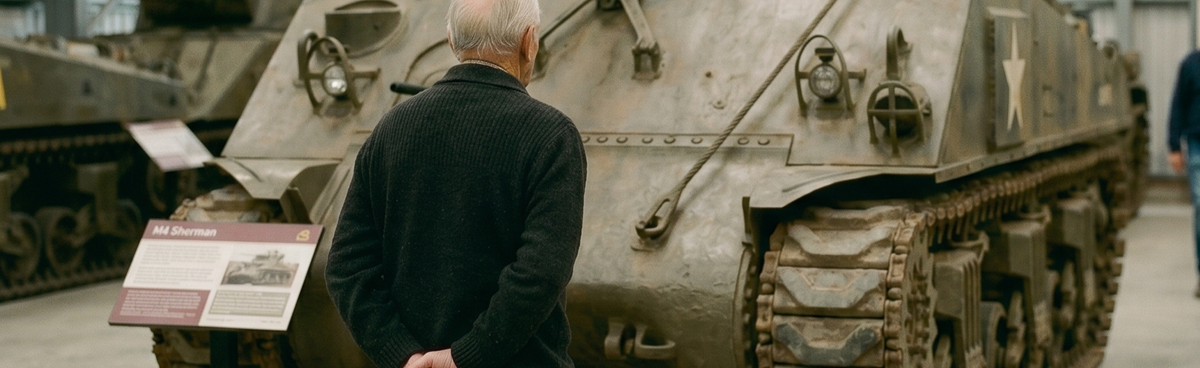
The History Beneath Our Feet
Drive the lanes between Whitchurch and Wem on a clear day and you pass RAF Tilstock — or rather, what remains of it. The old hangars still stand. The perimeter roads still trace their wartime logic across the farmland. Between 1942 and 1946, No. 81 Operational Training Unit operated from here, training aircrew on Whitley and Wellington bombers. Hundreds of men passed through this corner of North Shropshire during the war years — some of them local, many of them from further afield, all of them young.
The memorials in Wem and Whitchurch carry names. St Alkmund's Church in Whitchurch, St Peter's in Wem — the carved stone in both buildings represents not history in the distant, impersonal sense, but specific people from specific streets who did not come back.
This is the context in which we work. Some of our clients served. Some were the women who kept the farms and the factories running while the men were gone. Some were children during the war years whose earliest memories are air raid warnings and ration books and the particular silence of a town waiting for news. All of them were shaped by it in ways that are still present, every day, in how they move through the world.
When Memory and Service Become Inseparable
Many of the veterans we support are now living with dementia. This creates a particular dynamic that Armed Forces Day makes worth thinking about carefully.
Dementia attacks recent memory before it attacks deep memory. The name of this morning's carer may be gone by lunchtime. The events of last week may be entirely inaccessible. But the years of service — the discipline, the camaraderie, the rituals of military life, the moments of fear and the moments of extraordinary ordinary courage — are often among the last things to go. They are woven into procedural memory, into muscle memory, into the emotional bedrock of who a person is rather than the cognitive catalogue of what they have done.
A veteran with advanced dementia may not be able to tell you today's date, or recall your name, or follow a complex conversation. But show them a cap badge from their regiment and something shifts. The posture changes. The eyes focus. A story begins to emerge — haltingly, perhaps, in fragments — that is clearly being told from somewhere much deeper than the parts of the brain that dementia is currently reaching.
Understanding this changes how care is provided. It is not enough to know that a client was in the Royal Navy or served at RAF Shawbury or drove trucks across Europe in the early 1950s. It matters. Knowing it shapes how a carer approaches the morning visit, what they talk about, what they bring into the room, what they treat as important even when the person themselves can no longer explain why it feels important.
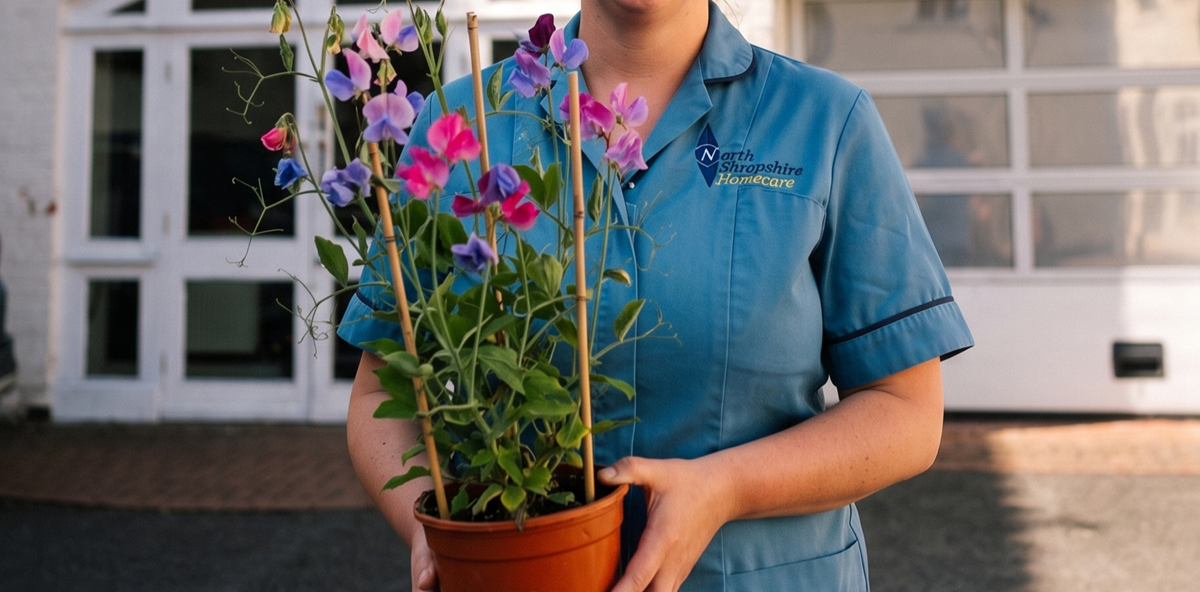
The Power of Objects — A Practical Note for Families
If you are struggling to connect with a relative who has advanced dementia, and conversation has become a barrier, the following is worth knowing.
The part of the brain that processes language and recent memory is often affected early in dementia. The part that processes sensory experience and emotion is frequently much more resilient. This is why the smell of something familiar can be more orienting than a name. Why a piece of music can unlock a mood or a memory that words cannot reach. And why physical objects — held, touched, examined — can bypass the verbal processing that has become difficult and trigger something much more immediate.
They are evidence — to the person holding them — that the life they lived was real, that the person they were still exists, that the service they gave was seen and is remembered. For someone whose sense of identity is being eroded by dementia, that evidence matters more than we can easily measure.
If you visit a veteran with dementia and conversation has become difficult, sit alongside them rather than opposite. Do not rush to fill silence. What sometimes happens, in the quiet, is a kind of recollection that words have been making harder rather than easier to reach.
What This Means for the Care We Provide
At North Shropshire Homecare, the care plan we write for a veteran is different from the care plan we would write for someone whose life story does not include service.
Not dramatically different — the medication still needs managing, the personal care still needs providing, the security call still needs making. But within all of that, there is a layer of specific knowledge about who this person was and what shaped them. We want to know which branch they served in. Whether they were stationed locally or far from home. Whether they served in peacetime or saw action. Whether service is something they talk about readily or something private and deep.
We want to know because care that ignores this history is not actually seeing the person. And care that does not see the person is not worthy of the name.
Knowing that a gentleman likes his tea made a particular way because that is how it was done on the ship he served on — that is not a small detail. It is a daily act of recognition. Knowing that a lady keeps her home to a standard that has always been about discipline and pride rather than habit — that is not just a cleaning preference. It is who she is.
Armed Forces Day is a formal occasion for remembering what our veterans gave. For us, the remembering is woven into every visit.
A Note on the Generation Who Did Not Serve
Not every client who was shaped by the war years wore a uniform. The women who worked the farms and the factories, who raised children alone, who managed on rations and made do and carried the anxiety of waiting — this generation is equally remarkable and equally present in the people we care for.
Their contribution is less formally commemorated, and perhaps for that reason more easily overlooked. We try not to overlook it.
If You Have a Veteran in Your Family
If you have a relative who served — and who might benefit from care that is informed by that service, that takes it seriously, and that approaches their history with the respect it deserves — we would be glad to talk.
Dementia support, companionship, medication management, complex care, security calls, personal care — whatever form the support needs to take, we will provide it with full knowledge of who this person is, not just what they need.
Call us on 01948 411222, or come and find us at The Coach House on Green End in Whitchurch. It would be our honour.
North Shropshire Homecare The Coach House, 15/17 Green End, Whitchurch, SY13 1AD Serving Whitchurch, Wem, Prees, Whixall, and the surrounding villages of North Shropshire since 2011.