How Do We Get More Young People Into A Career In Care?
There is a shortage of care workers in this country that isn't going away, and every attempt to fix it so far has made the same mistake: treating it as a recruitment problem when it's actually a perception problem, and a perception problem that starts far earlier than anyone in this sector usually thinks to look.
We advertise for carers the way most companies advertise for staff — job boards, local Facebook groups, our new insta, the occasional poster in a shop window. What we don't do, and what almost nobody in this sector does, is talk to children. And we think that's exactly backwards, because by the time someone is eighteen and filling in a job application, most of what they think about care work was decided years earlier, usually without anyone actually explaining what the job involves.
So this post is about what we think actually needs to change, and one specific thing we're going to do about it.
What Young People Currently Think Care Work Is
We asked around — informally, among our own younger carers, what they thought care work involved before they actually started doing it. The answers were fairly consistent, and fairly wrong.
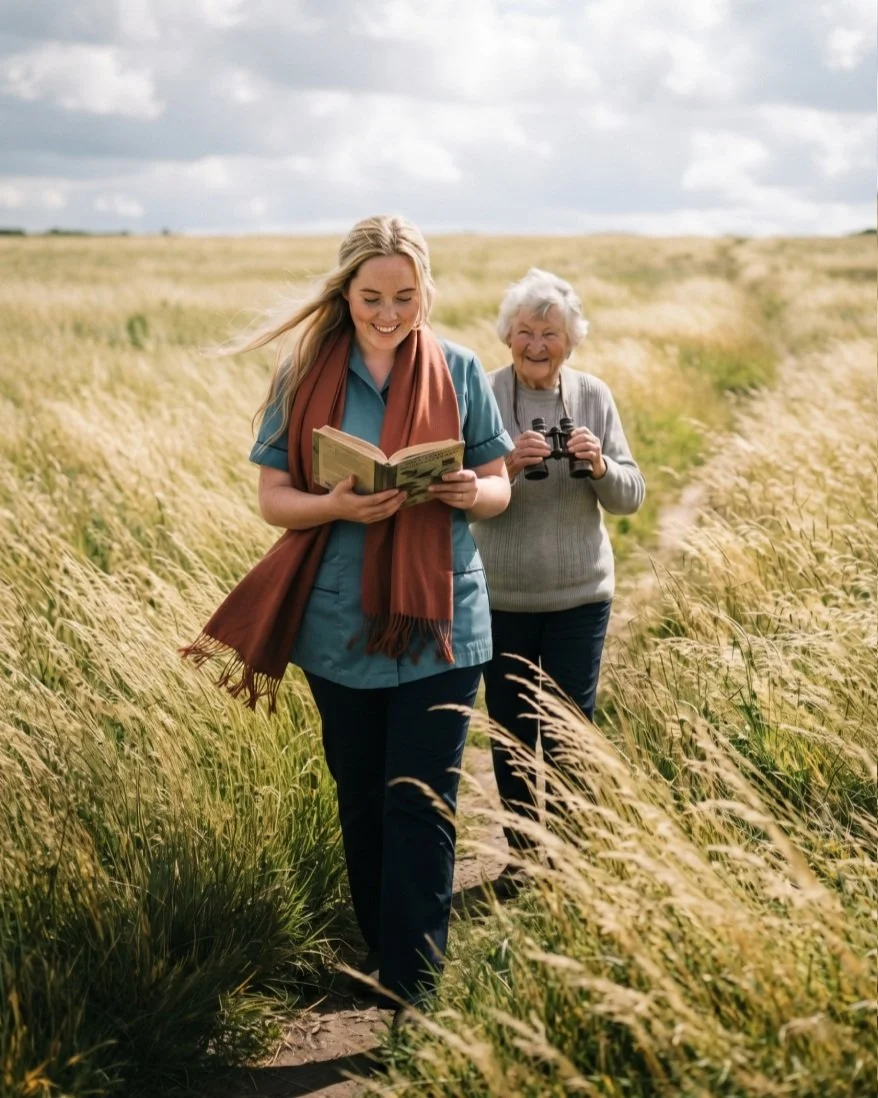
Most assumed it meant something close to cleaning — wiping surfaces, emptying bins, a slightly more personal version of housework. A few thought it was essentially medical, closer to nursing than it actually is, and were surprised by how much of the job is conversation, patience, and genuine relationship rather than clinical procedure. Almost nobody, before they started, had any idea that a carer might spend part of a morning talking to someone about the wheat harvest, or learning the specific way a client likes their toast, or sitting with someone through a difficult afternoon simply because being present mattered more than any task on the list.
Nobody had been told that care work is, at its best, one of the most skilled, most emotionally intelligent, most genuinely meaningful jobs available to them. They'd absorbed, from somewhere, that it was a fallback option — something you did if nothing better came along, rather than something you might actually choose.
That perception forms early. It forms in primary school, from the jobs children see represented in books, on television, in the career days that visit schools. Firefighters, doctors, vets, astronauts, footballers. Nobody comes in to talk about care work, because nobody thinks an eight-year-old needs to hear about it yet.
We think that's the actual gap.
Why This Matters More in Rural Areas Than Anywhere Else
In a city, a care shortage is inconvenient. In North Shropshire, it's structural. We've written before about why we only employ carers who live locally — punctuality, community knowledge, the relationship between a carer and the neighbourhood they work in. That model only functions if there's a genuine pipeline of local young people who see care as a real, viable, respected career choice, rather than something to fall into after everything else has been tried.
If every generation of young people in Whitchurch, Wem, and the surrounding villages grows up without ever seriously considering care work, the local model we believe in eventually runs out of people to sustain it. This isn't an abstract long-term worry. It's the practical, unglamorous foundation of whether rural care survives at all in twenty years.
What We Think Actually Works
Start earlier than seems necessary. Career awareness in most schools begins around Year 9 or 10, when students are already choosing GCSE options with half an eye on future paths. By then, the idea that care work is a fallback is often already fixed. We think the conversation needs to start in primary school — not as career guidance exactly, but simply as representation. Children who grow up seeing care work portrayed as skilled, kind, and respected are considerably more likely to consider it seriously a decade later, in the same quiet way a child who grows up around books is more likely to become a reader.
Show the actual job, not the assumed one. School visits from carers who can talk honestly about what the job involves, and — genuinely — young people simply meeting our team and asking questions, do more to shift perception than any recruitment advert we've ever run. We've said before that we're always glad to host informal conversations for anyone curious about care as a career.
📞 01948 411222 ✉️ mail@nshomecare.co.uk
North Shropshire Homecare The Coach House, 15/17 Green End, Whitchurch, SY13 1AD