
On Sonder — And Why It Might Be THE Most Important Word in Care
A reflective piece on a made-up internet word, written on a train to Shrewsbury, Trying to explain what it means to actually see the people we work with and for.

There's a word… well not really a word, more a coined term that escaped into general use from the net because it named something real that had no name before — called sonder.
It describes the sudden, vivid realisation that every stranger around you is living a life every bit as complicated, vivid, and central to themselves as your own. Not an abstract idea you nod along to. A genuine, momentary vertigo: that person over there has a whole interior world — a childhood, a heartbreak, a private joke with someone they love, an argument they're still turning over — running at full volume, and you will never hear a note of it.
I feel it now on the train to Shrewsbury.

There's something about that specific journey, the flat fields going past, the strangers getting on and off at their stops, someone's phone conversation half-overheard, a woman doing a crossword with real concentration, a teenager staring out the window looking like they're somewhere else entirely — that makes the feeling land square in my chest. Every single person in that carriage is the main character of an entire life I will never know anything about. And then the train pulls into Shrewsbury, and everyone disperses, and the moment passes, the way it always does.
I think about this a lot in relation to the work we do since learning the word. And now I think it might be one of the most useful ideas a person in care can carry around with them, quietly, every day.
The Sadness of Familiarity
Here's the uncomfortable truth about some care work, or any work where you see the same people repeatedly: familiarity is efficient, and efficiency is the enemy of sonder.
By the tenth visit, you know the routine. You know how Margaret takes her tea, which chair she sits in, what time she likes the curtains opened. This knowledge is good — it's the foundation of consistent, personal care, and we've written extensively about why it matters. But there's a quiet risk buried inside that same familiarity: it's very easy for "knowing someone's routine" to slowly calcify into "knowing someone," full stop — as though the parts of a person you've observed across thirty-minute visits are the whole of who they are.
They are not. They never are. The person sitting in that chair, waiting for their tea, was a teenager once with a crush they never told anyone about. They had a first day at a job that terrified them. They made a decision at twenty-three that they still think about at eighty. They have opinions about things we've never discussed, a private grief we've never been told about, jokes they used to make that made a whole room laugh. All of that is still in there — present, complete, running at full volume — whether or not it ever surfaces during a medication round.
Sonder, applied deliberately to care work, is the discipline of remembering that the thirty minutes we spend with someone is a tiny, tiny fraction of who they actually are. It's a check against the specific, quiet arrogance of assuming that our version of a person — the version we see, tired, in need of help, in their dressing gown at 8am — is the real one, rather than simply the one we happen to be present for.
What This Can Actually Looks Like in a Care Visit
This isn't just a nice(?) feeling to have on a train. It has practical consequences for how we actually do the job, and we think it makes us measurably better at it.

It changes how you listen. If you genuinely believe someone's whole life is as complex and vivid as your own, you stop treating their stories as background noise to be politely endured while you get on with the task list. The story about the dog they had in 1974 isn't a distraction from the visit. For thirty seconds, it is the visit — and it might be the only part of the day where that person felt properly seen rather than managed.
It changes how you interpret difficult behaviour. A client who's short-tempered, or resistant to care, or seemingly ungrateful, is a lot easier to respond to with patience if you're actively holding onto the idea that you're seeing perhaps five minutes of a very long, very difficult day that started at 4am with pain, or fear, or a memory that surfaced uninvited. Sonder doesn't excuse unacceptable behaviour, but it reliably makes the first response the right one, rather than the defensive one.
It changes how you write a care record. "Client appeared low today" is efficient and says almost nothing. A carer holding onto sonder writes something closer to what actually happened — what was said, what seemed to trigger it, what helped — because they're treating the note as a record of an actual person's actual day, not a box that needs ticking before the next visit.
It changes how you treat the family, not just the client. The exhausted daughter who snaps at you on the doorstep because she hasn't slept in three days is not "a difficult family member." She's a whole, complicated person whose life you're seeing five minutes of, on what might be the worst week of her year. Sonder applied to families as much as clients tends to produce the kind of grace that actually helps, rather than the kind of professional distance that just protects you.
This Also Matters for Managing People, Not Just Caring for Them
Here's the part I think about most, because I run part of an organisation and this isn't only about client visits. Sonder applies exactly as much to the person on the other side of a supervision meeting.
It is very easy, in our weaker moments of running a care team, to see a carer only through the lens of their performance — punctual or not, thorough or not, good at documentation or not. That lens is necessary. It's also dangerously incomplete in exactly the same way it's incomplete for a client.
The carer who seems distracted this week has a life running at full volume outside the fifteen minutes you spend reviewing their week — a relationship struggling, a child who's unwell, a grief they haven't mentioned because the supervision meeting didn't feel like a safe place for it.
Managing people well, I think, starts from the same discipline as caring for people well: actively resisting the temptation to believe the slice of someone you see is the whole of them. A manager who holds onto that tends to ask better questions, notice earlier when something's wrong, and build the kind of trust that makes a team actually tell you what's happening rather than performing "fine" until they quietly leave.
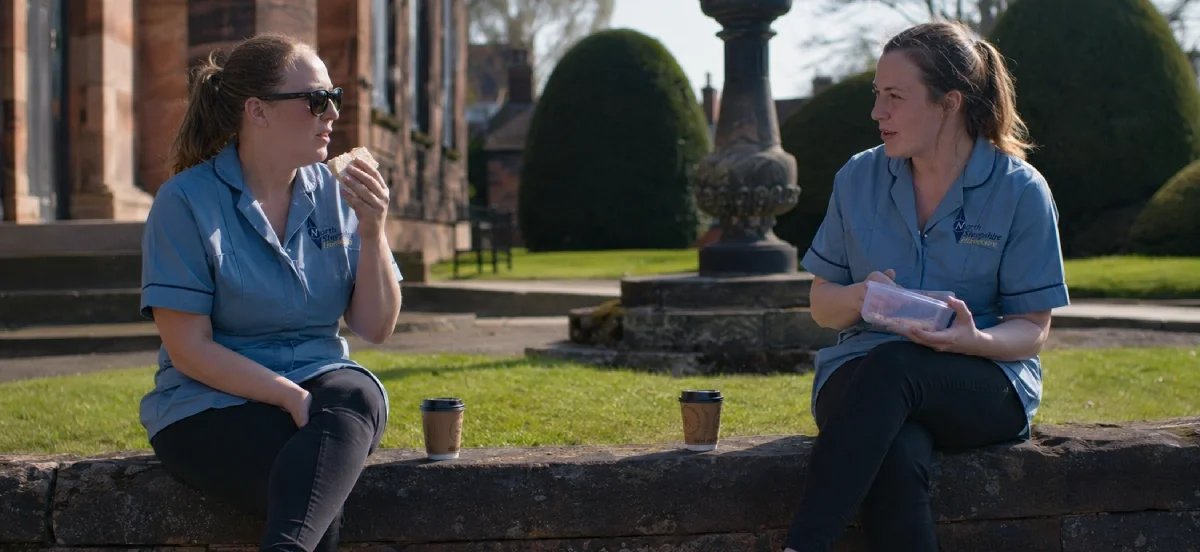
We talk a great deal on this website about consistency of carer, about knowing a client's life story, about treating people as whole individuals rather than a list of needs. I think the honest version of that principle has to include everyone in the relationship — the client, the family, and the carer standing at the door. Sonder doesn't stop being true just because someone's wearing our uniform instead of receiving our care.
The Train Keeps Arriving At My Front Door
I don't think this feeling is sustainable at full intensity, all the time.. nobody could hold that much emotional weight for every stranger, every day, and still function. But I think it's worth returning to, deliberately so, the way you'd return to a piece of music you love. On the train to Shrewsbury. In the moment before knocking on a client's door. In the two minutes before a supervision meeting with someone on the team.
Just a small, repeated reminder: this person, whoever they are today, is the entire centre of their own enormous life. I am seeing a sliver of it. The sliver is real, but it is not remotely the whole story.
I think that's a good thing to carry into every visit we make in North Shropshire, and every conversation we have with the amazing people who make those visits happen.
If any of this resonates and you'd like to talk to us — about care, about working with us, or just about the trains to Shrewsbury — we're always glad to hear from you.
📞 01948 411222 ✉️ mail@nshomecare.co.uk
North Shropshire Homecare The Coach House, 15/17 Green End, Whitchurch, SY13 1AD