
A Note from North Shropshire Homecare: We recently invited the team at CareLineLive to write a guest post explaining the digital eMARs (electronic Medication Administration Records) and notes system we use every day. We want to be completely transparent: this is not a sales pitch, and they aren't paying us to feature this. In fact, we are paying customers of CareLineLive. We asked them to share this because their software is a crucial part of how we deliver safe, connected care. We want our clients and their families to fully understand the tools working behind the scenes to protect and support their loved ones. Here is Nathalie from CareLineLive to explain what good digital care really looks like.
By Nathalie Vallejo (Partnership and Events Lead) with contributions from the CareLineLive by Evaran team.
A few months ago, as part of a marketing campaign our team at CareLineLive was working on, I watched a carer at work in someone's home. What struck me wasn't the technology, it was how little of it you actually saw.
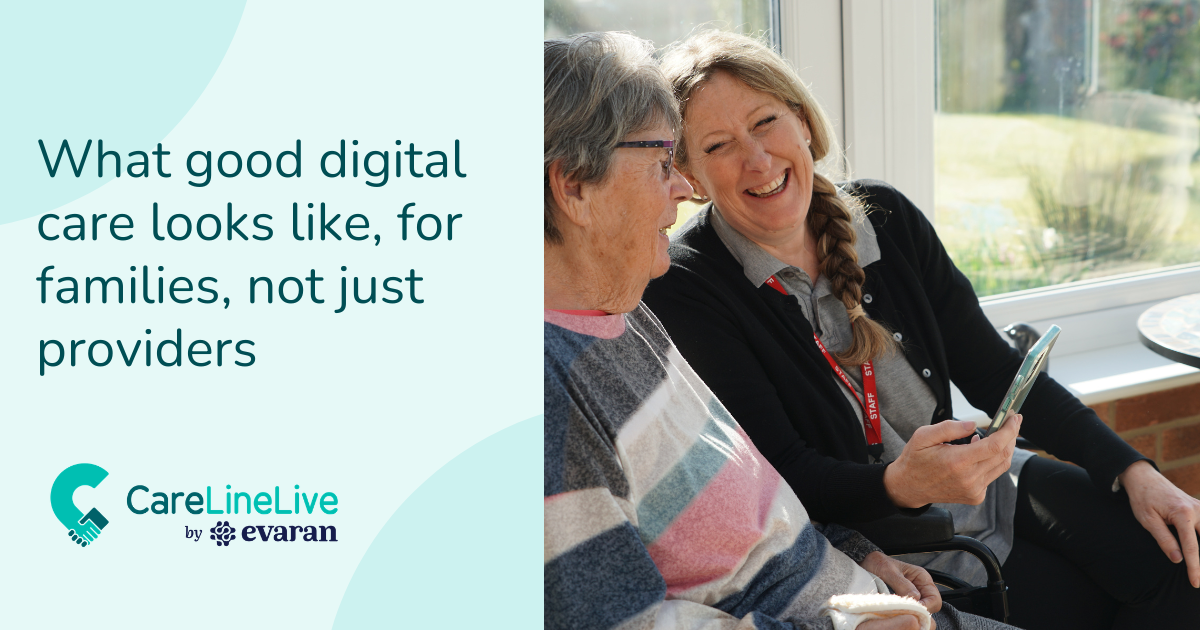
She moved through her updates on her phone in moments: medication logged, notes added, all done in the time it might have taken to write a line on a paper chart. What that gave her back was time. Time to sit with the woman she was caring for. Time to share a laugh and a box of chocolates. Time to take the client out in her wheelchair for some fresh air, out of the house and into the day.
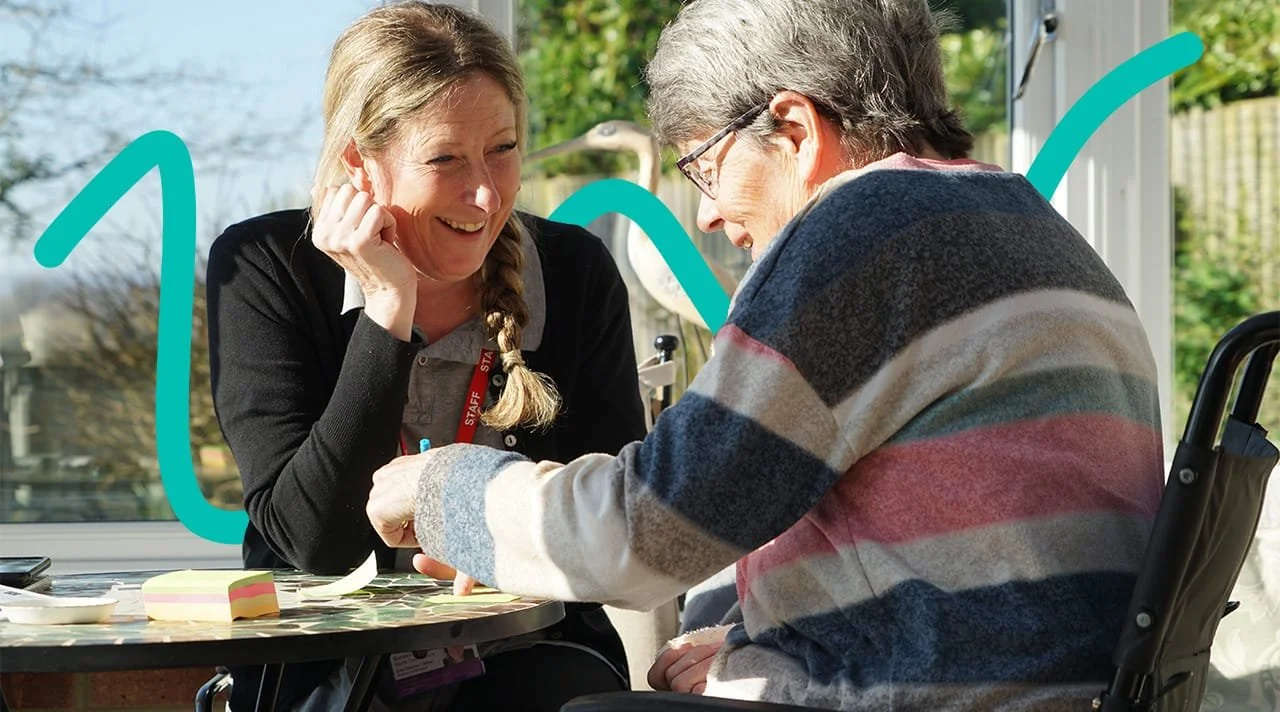
Nearby, her husband was there too, visibly tired, but smiling despite everything his wife’s condition now asks of them both. He talked about how hard some days are. He also talked about how much the carer's visits mean, not just to his wife but to him. Watching them, it was easy to imagine being their daughter, living some distance away, opening an app that evening and seeing exactly this: a note, maybe a photo, proof that her mother had been laughed with, taken outdoors, properly cared for not just "seen to."
That's what good digital care management is really for. Not the technology itself but what it makes possible: more time for the human part of caring and real reassurance for the families who can't be there every day.
Why this matters just as much for a small, local provider as a large one
It would be easy to assume this kind of reassurance is only possible for large providers with big teams and bigger budgets. But it isn't. As CareLineLive’s Product Owner, David MacDougall, puts it: "The size of a business is no indication of the level of care they provide, or even the complexity of the needs of the people they support." A small to medium local provider, the kind that knows every family by name, can offer exactly the same safety net as a much larger one, provided they have the right system behind them.
That's especially true for a provider like North Shropshire Homecare, working across a wide, rural patch where families are often spread out and the nearest support might be a significant drive away. Good software doesn't replace the relationship between a carer and the person they look after. It protects it by making sure nothing falls through the cracks around it.
Care Circle Portal: the family-facing heart of it
Day to day, the part of CareLineLive that matters most to families is the Care Circle Portal. It gives families, and where appropriate advocates or health professionals, direct access to completed visit records, medication logs and carer observations, updated in real time rather than written up hours later.
For a family member living some distance away, or simply unable to be there for every visit, that means not having to wonder. Was Mum's medication given? Was she in good spirits today? Did anything need flagging? The answer is there, as it happens, rather than pieced together after the fact. This is especially important when service users have dementia as they can often get confused about whether a visit has happened, whether they have had their lunch or medications. In the past this would involve the relative calling the office of the care provider to check. With the Care Circle Portal all they need to do is a quick check on their phone and they can immediately reassure their relative that they have indeed had their visit that morning.
It also means the circle around a person's care is genuinely joined up, not just family, but anyone involved in someone's wellbeing, all seeing the same accurate picture. In a rural community like North Shropshire, where a person's care might involve family, a GP and a small local team all trying to stay in step, that shared visibility matters enormously.
Continuity that doesn't rely on memory
Care rarely comes from just one carer. Over a week, several different people might visit the same person and what matters most is that nothing gets lost between one visit and the next.
That's where the everyday detail of eMAR and care notes makes the difference. Medication is logged the moment it's given, not written up later from memory. If a carer notices something worth flagging like a change in a condition, a knock, anything out of the ordinary, they can note it and, if needed, photograph it, so the next carer and the office know before they even arrive. Nothing has to wait for a shift change or a phone call that might not get made until later in the day.
For a family, this kind of continuity is invisible when it's working well, which is rather the point. It just means whoever turns up to help their loved one, on whatever day, already knows what's going on.
Real-time monitoring: why it matters more in rural areas
There's a particular kind of worry that comes with rural care that's easy to overlook if you haven't experienced it. A missed visit on a quiet farm track, at the end of a long, unlit lane, isn't the same as a missed visit on a city street where someone might notice within minutes. It can go unnoticed for far longer, and for a family, that gap is frightening.
Real-time call monitoring changes that. Every visit is logged with GPS location as it happens, so if a carer is running late or a visit hasn't started when it should have, the office knows immediately, not at the end of the day and not when a family calls to check. As David puts it, that additional layer of accuracy "provides that extra peace of mind for family and friends to know that their loved ones are going to be seen and carers know how and when to get to them."
For a provider covering the distances that North Shropshire Homecare does, that isn't a nice-to-have. It's the difference between hoping everything is fine and knowing it.
GP Connect: no more guessing games
For families, one of the most stressful things isn't a single dramatic mistake, it's the small, nagging uncertainty. Has the agency got the right medication information? The right dosage? What happens if there's a query and nobody can reach the GP quickly?
GP Connect removes that uncertainty. With a service user's consent, carers can view relevant parts of their GP record directly, including current medications and allergies, in real time. That means no phone calls to family asking what tablet Mum takes and in what quantity and no anxious wait while someone tries to track down a GP surgery for an answer. The information is simply there, accurately, when it's needed.
It's a feature North Shropshire Homecare knows well. Alice Allen has described GP Connect's integration with CareLineLive as a "godsend," and it's easy to see why. For a family, it means one less thing to worry about. For a small to medium local provider, it means offering the kind of safety and accuracy you'd expect from a much larger organisation, without the layers of admin (and all the hours on the phone to GP surgeries) that might otherwise slow things down.
A natural fit with how North Shropshire Homecare already works
None of this replaces good care. It supports it. North Shropshire Homecare already goes further than most in being open about how they work, publishing a full example care plan for families to see before they ever need one. A joined-up digital system is simply an extension of that same value: nothing hidden, nothing guessed at and a family always able to see exactly what's happening for the person they love.
A Final Thought from Us:
First, a huge thank you to Nathalie and the team at CareLineLive for taking the time to share their insights with us. We hope this gives you a clearer picture of the technology supporting our care team at North Shropshire Homecare.
Day in and day out, we find CareLineLive invaluable for keeping our records accurate, our team connected, and our families in the loop. Our priority will always be doing what’s best for our clients, which means continuously holding our tools and systems to the highest standards. Right now, we firmly believe CareLineLive is the best system out there to support that mission. We are proud of the transparency, safety, and peace of mind it helps us bring to the families we care for.