Pressure Sore Prevention and Wound Care at Home in North Shropshire
Have this page read to you

Pressure sores are one of the most serious, most costly, and — critically — most preventable complications in home care. They are also, in our experience, one of the most consistently underestimated.
Around 700,000 people in the UK develop a pressure ulcer every year. Pressure injuries cost the NHS more than £1.4 million every single day — between £1.4 and £2.1 billion annually, representing approximately 4% of the entire NHS budget. Most of that cost is nursing time spent treating damage that, in the great majority of cases, should never have occurred in the first place.
The cost to an individual treating a single pressure ulcer ranges from £1,064 for a Grade 1 injury to £10,551 for a Grade 4 injury — the most severe category, where the wound extends down to muscle, tendon, or bone. Older people make up the population most affected in community care settings, and the consequences extend well beyond financial cost: pressure ulcers are associated with longer hospital stays, increased falls risk, sleep deprivation, infection, and — in severe cases — death.
This is not a page about a rare or exotic complication. It is a page about one of the most common, most consequential, and most preventable risks that older and immobile people face at home — and about the daily, unglamorous, absolutely essential care that prevents it.
At North Shropshire Homecare, pressure area care is not a separate service. It is woven into every visit we provide to every client whose mobility, nutrition, or skin condition places them at risk — across Whitchurch, Wem, Prees, Whixall, and the surrounding villages of North Shropshire.
Understanding Pressure Sores — What They Are and Why They Happen
A pressure sore also called a pressure ulcer, pressure injury, bedsore, or decubitus ulcer — is localised damage to the skin and underlying tissue, usually over a bony prominence, caused by sustained pressure, shear, or friction. When pressure on an area of skin is maintained for too long, blood flow to that area is restricted. Without adequate blood flow, the tissue is starved of oxygen and nutrients, and it begins to break down.
The areas most at risk are those where bone sits close to the skin surface with minimal cushioning muscle or fat in between — the sacrum (base of the spine), heels, hips, elbows, shoulder blades, and the back of the head. For a person lying in the same position for an extended period, or sitting in a chair without adequate repositioning, these are the points where damage begins.
The Grading System
Pressure sores are classified using a standard grading system that describes the depth and severity of tissue damage:
Grade 1 — non-blanchable erythema. The skin is intact but shows persistent redness that does not turn white when pressed. This is the earliest visible sign of pressure damage and the point at which intervention is most effective and least costly.
Grade 2 — partial thickness skin loss. The skin is broken, presenting as a shallow open wound or blister. The underlying tissue is beginning to be affected.
Grade 3 — full thickness skin loss. The wound extends through all layers of skin into the subcutaneous fat, though not to muscle or bone. Significant tissue loss is visible.
Grade 4 — full thickness tissue loss extending to muscle, tendon, or bone. This is the most severe category, carrying the highest risk of serious infection, and the most expensive and slowest to heal.
Unstageable and deep tissue injury — categories where the true extent of damage cannot be immediately assessed, either because the wound bed is covered by dead tissue (unstageable) or because damage to deeper tissue is suspected beneath intact skin that appears discoloured (deep tissue injury). These require prompt clinical assessment.
The critical point about this grading system is this: only 5% of patients who are correctly identified as at risk and given appropriate preventive care go on to develop a pressure sore. The overwhelming majority of pressure damage is preventable through consistent, correctly applied care. This is why we take it as seriously as we do.
Who Is at Risk — And Why
Understanding the specific risk factors for pressure damage is the foundation of effective prevention. We assess these factors formally for every client with reduced mobility, and we build the prevention plan around the specific combination present in each individual.
Reduced Mobility
The single most significant risk factor. Anyone who cannot independently change position — whether due to paralysis, severe weakness, advanced frailty, sedation, or unconsciousness — cannot relieve pressure on vulnerable areas without assistance. This includes clients with spinal cord injury, advanced Parkinson's or MND, stroke with significant hemiplegia, advanced dementia, and anyone in the later stages of a terminal illness.
Poor Nutrition
Malnutrition is directly linked to pressure ulcer development. Protein is essential for tissue repair and maintenance, and inadequate protein intake significantly reduces skin and tissue resilience. Dehydration reduces skin elasticity and blood volume, both of which increase vulnerability to pressure damage. Research has specifically demonstrated an association between pressure ulcer development and malnutrition as measured by standard nutritional risk screening tools.
Incontinence
Prolonged contact with moisture — urine, faeces, or sweat — softens and weakens the skin, making it significantly more vulnerable to breakdown from pressure and friction. Moisture-associated skin damage frequently coexists with and complicates pressure injury.
Reduced Sensation
Conditions that impair sensation — diabetic peripheral neuropathy, spinal cord injury, stroke, advanced dementia affecting the ability to communicate discomfort — remove the body's natural warning system. A person with normal sensation shifts position frequently, often unconsciously, in response to the discomfort of sustained pressure. A person who cannot feel that discomfort does not shift, and the pressure continues unchecked.
Poor Circulation
Conditions affecting blood flow — peripheral vascular disease, diabetes, heart failure — reduce the tissue's ability to withstand pressure and to recover from minor damage. Smoking further compromises circulation.
Age and Skin Fragility
Skin becomes thinner, less elastic, and more fragile with age. The subcutaneous fat layer that provides natural cushioning over bony prominences diminishes. This is why older people are disproportionately represented among those who develop pressure injuries.
Medical Equipment
Medical device-related pressure injuries occur where equipment — oxygen tubing, catheters, splints, ill-fitting slings — creates sustained localised pressure on the skin. This is a specific and frequently overlooked risk category that requires deliberate attention.
Combined Risk
Most of our clients at highest risk have several of these factors simultaneously — the person with advanced Parkinson's who is also underweight and has some urinary incontinence; the person recovering from a stroke with hemiplegia, reduced appetite, and a degree of confusion. Risk assessment must consider the whole clinical picture, not a single factor in isolation.
Our Prevention Approach — What We Actually Do
Daily Skin Assessment
Every personal care visit for a client identified as at risk includes a skin check — a genuine, deliberate inspection of every pressure point relevant to that person's position and mobility, not a cursory glance.
We check the sacrum, the heels, the hips, the elbows, the shoulder blades, the back of the head for bed-bound clients, and the ischial tuberosities (sitting bones) for chair-bound clients. We look specifically for non-blanchable redness — pressing gently on any red area to see if it whitens and then returns to red (a normal response) or stays red (an early warning sign requiring prompt action).
We document what we find at every visit — not vaguely, but specifically: location, size, colour, whether it blanches, whether it has changed since the previous check. This documentation is not a formality. It is the clinical record that allows early damage to be caught and addressed before it progresses, and it is the evidence that demonstrates good care has been provided consistently.
Repositioning
For clients who cannot reposition themselves, a structured repositioning schedule is one of the single most effective preventive interventions available. The standard interval is every two hours for a person at high risk, though this is adjusted based on individual risk level, skin condition, and the pressure-relieving equipment in use.
We implement repositioning schedules precisely — turning at the correct interval, using the correct technique (a full lateral turn to a 30-degree angle rather than a 90-degree side-lying position, which concentrates pressure directly over the hip), and documenting every repositioning event.
For clients who spend time in a chair or wheelchair, we support regular weight shifts and pressure relief — encouraging independent movement where the person is able, and providing assisted repositioning where they are not.
Equipment
The correct pressure-relieving equipment is essential and must match the individual's specific risk level and clinical situation.
Mattresses — from basic foam pressure-relieving mattresses for lower-risk clients through to dynamic alternating-pressure air mattresses, powered by a motor that continuously shifts the distribution of pressure, for higher-risk clients. We ensure that the mattress in use matches the current risk assessment, and we flag to the district nursing or tissue viability team when we believe the current equipment is no longer adequate for a client's changing needs.
Cushions — pressure-relieving cushions for chair and wheelchair use, selected and fitted according to the individual's risk level and body shape.
Heel protection — heels are one of the most commonly missed pressure sites because they are easy to overlook during general care. Heel protector boots or careful positioning with pillows to fully offload the heel from the mattress surface are essential for at-risk clients.
Positioning aids — wedges, pillows, and specialist positioning equipment used to maintain the correct lateral angle during repositioning and to offload pressure from vulnerable areas during rest.
We check that equipment is functioning correctly at every visit — that an alternating pressure mattress motor is actually running, that a cushion has not degraded or deflated, that heel protectors are correctly fitted rather than simply present in the room.
Nutrition and Hydration
Because nutritional status is so directly linked to skin integrity and wound healing capacity, nutritional support is a core part of our pressure prevention approach, not a separate consideration.
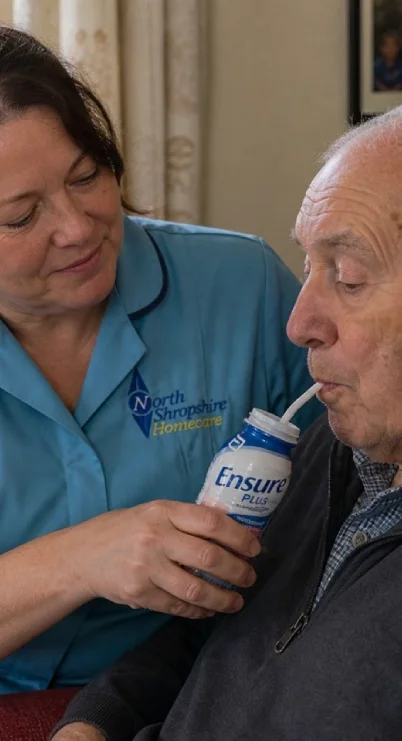
We monitor food and fluid intake for at-risk clients. We prepare protein-rich meals where nutritional support is part of the care plan, working with dietitian guidance where this has been provided. We ensure adequate hydration, which supports both general skin health and the physiological processes involved in healing. Where we observe declining appetite or nutritional intake in an at-risk client, we communicate this promptly, because addressing nutrition proactively is far more effective than trying to heal an established wound in a malnourished person.
Skin Care
Good general skin care reduces vulnerability to pressure damage. We keep skin clean and appropriately moisturised — dry, cracked skin is more vulnerable to breakdown than well-hydrated skin. We manage incontinence promptly and thoroughly, using appropriate barrier creams to protect skin from moisture damage. We avoid vigorous rubbing or massage directly over bony prominences, which was once standard practice but is now understood to potentially cause rather than prevent tissue damage.
Continence Management
Where incontinence is a contributing risk factor, prompt and thorough continence care is a direct pressure prevention intervention, not merely a dignity consideration (though it is emphatically that too). We change soiled continence products promptly, clean and protect the skin thoroughly at every change, and use appropriate barrier products to protect skin from ongoing moisture exposure between changes.
When a Wound Has Already Developed
Despite the best prevention efforts, pressure sores sometimes develop — particularly in clients whose risk factors are severe, whose condition is deteriorating rapidly, or who were already at an advanced stage of injury before care began.
When we identify a new pressure sore, or when a client comes into our care with an existing wound, our role changes but does not diminish.
We do not treat wounds ourselves. Clinical wound care — debridement, specialist dressing selection, wound bed management — is a district nursing responsibility. What we provide is the daily support that makes clinical wound healing possible: precise repositioning to offload pressure from the wound site, nutritional support for healing, monitoring for signs of deterioration or infection between district nursing visits, and prompt, specific communication when something has changed.
We monitor for infection. Increasing redness or warmth around a wound, increasing pain, unusual odour, discharge that has changed in colour or volume, or fever in the client — any of these warrant prompt communication to the district nursing team or GP, because infected pressure wounds can progress rapidly and, in severe cases, become life-threatening.
We support dressing regimens. Where a dressing schedule has been established by the district nursing team, we support the client between nursing visits — ensuring dressings remain intact, reporting if a dressing has become dislodged or soiled, and never attempting to change a clinical dressing ourselves without specific training and instruction to do so.
We document healing progress. Wound size, appearance, and any change are recorded consistently, providing the district nursing team with observations from the days between their visits — which is often when the most clinically useful information about how a wound is progressing actually exists.
A Note on Accountability
To the extent that pressure ulcers are largely avoidable, pressure damage that develops under a care provider's watch is increasingly understood — both clinically and legally — as a potential marker of inadequate care. NHS litigation payouts related to pressure injury have run into tens of millions of pounds annually in recent years.
We take this seriously not because of litigation risk but because it reflects something more fundamental: pressure sores are largely preventable, and a client who develops one under our care represents, in most cases, a failure of the attention and consistency that good care requires.
We hold ourselves to the standard that prevention should be the default outcome, not the exception. Where a wound does develop despite best efforts — which can happen in clients with severe combined risk factors, or in the final stages of terminal illness where tissue viability is compromised beyond what any care regimen can fully protect against — we are honest about it, we document it thoroughly, and we work with the family and clinical team without defensiveness.
Working With District Nursing and Tissue Viability Services
Pressure area management in the community is a genuinely multidisciplinary responsibility. District nurses lead on clinical wound assessment and treatment. Tissue viability nurses provide specialist input for complex or non-healing wounds. Dietitians support nutritional optimisation for healing. Occupational therapists assess and provide specialist seating and positioning equipment.
We work within this team as the consistent daily presence that implements the prevention plan, observes changes between clinical visits, and communicates promptly and specifically when something needs professional attention. We do not wait for a scheduled review to report a new area of redness or a wound that has changed in appearance.
Arrange a Free Home Assessment
If you or a family member has reduced mobility, existing pressure damage, or other risk factors for pressure sores, and would benefit from specialist home care support in North Shropshire, we would be glad to talk.
A free home assessment costs nothing and commits you to nothing. We visit, we assess, and we give you an honest picture of what we can provide.
📞 01948 411222 — 24 hours, 365 days
✉️ mail@nshomecare.co.uk
North Shropshire Homecare
The Coach House, 15/17 Green End, Whitchurch, SY13 1AD
Providing specialist pressure sore prevention and wound care support at home across Whitchurch, Wem, Prees, Whixall, Higher Heath, Tilstock, Ash, and the surrounding villages of North Shropshire. CQC Rated Good. Independently Owned. Locally Staffed.
Further Support and Information
NHS — Pressure Ulcers
Overview of pressure sores, causes, and prevention.
nhs.uk
Tissue Viability Society
Professional body for tissue viability nurses and specialists.
tvs.org.uk
NICE Guidelines — Pressure Ulcers
Clinical guidance on the prevention and management of pressure ulcers.
nice.org.uk
Royal Shrewsbury Hospital — District Nursing Referrals
Access via GP referral for community wound care and tissue viability support.
Tel: 01743 261000
Shropshire Council Adult Social Care
Needs and financial assessments for council-funded care, including equipment provision.
Tel: 0345 678 9044
Age UK Shropshire Telford & Wrekin
Free benefits advice including Attendance Allowance for older adults with mobility-related needs.
Tel: 01743 233123
-
The information on this page has been checked for clinical accuracy and aligns with current best practices for Pressure Sore Prevention and Wound Care.
REVIEWED BY: Alice Allen CQC Registered Manager
Next review July 2027.