
Complex Care at Home in Shropshire
There is a moment that happens in a lot of hospital corridors, and increasingly in a lot of front rooms across Whitchurch, Wem, and the villages of North Shropshire. A diagnosis has landed, or an accident has happened, or a condition has progressed to the point where a machine is now part of daily life — and somewhere in the conversation that follows, a question sits unspoken because it feels almost embarrassing to ask out loud.
Can this person actually stay at home?
Not "should they." Not "is it sensible." Just — is it physically, practically, genuinely possible for someone with a ventilator, a feeding tube, a catheter, a tracheostomy, to live in their own house rather than a hospital bed or a nursing home corridor?
We get asked a version of this question several times a month. The honest answer, almost every time, is yes. And the fact that so many families are surprised by that answer says something about how poorly understood complex care at home actually is — even among people who are living through the exact situation it was designed for.
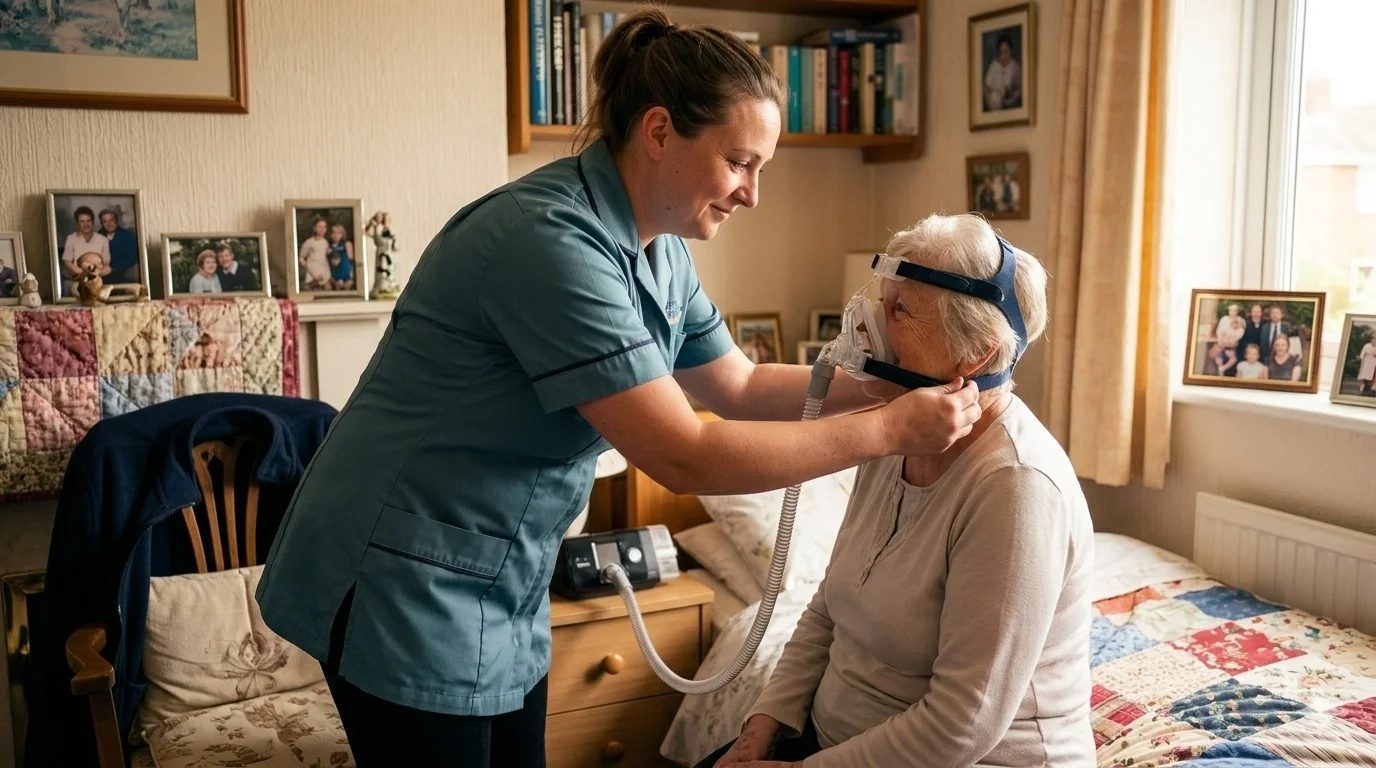
Why the Assumption Defaults to "No"
It is worth understanding where the assumption comes from, because it is not irrational. It comes from how complex medical equipment is usually first encountered: in a hospital. A ventilator on a ward is surrounded by monitors, alarms, a team of clinicians who can respond in seconds, and an entire building built around managing exactly this kind of risk. Seeing that environment, and then being told "this person needs a ventilator," it is a natural leap to assume the environment has to come with it.
It doesn't. The machine does the same job in a bedroom in Prees as it does in a ward in Shrewsbury. What changes is not the equipment — it is who is trained to manage it, how quickly help can be reached if something goes wrong, and whether the people around the equipment actually understand it. Strip away the institutional setting and what remains is a question about training, planning, and competent daily presence — all of which can exist in a home as completely as in a hospital.
The hospital is not what makes the care safe. The protocol is what makes the care safe. And a protocol travels.
What Actually Has to Be True for Home to Work
There are real conditions that have to be met, and being honest about them is more useful than blanket reassurance.
Someone has to be properly trained — not generally, specifically. A carer who has done a course on catheter care in the abstract is not the same as a carer who has been trained, in this house, on this person's exact catheter, by the district nursing team who manages it. Generic competence is not enough for complex care. The training has to be built around the individual.
There has to be a real plan for things going wrong, not just things going right. What happens if the ventilator alarms at 3am? Who is in the house, what do they do, and at what point do they call 999 rather than trying to fix it themselves? A complex care package that has not answered this in writing, in detail, before the first night, is not actually ready yet.
The home itself has to be assessed honestly. Not every property is immediately suitable. Access for equipment, space around a bed for two carers to safely reposition someone, power supply reliability for anything battery-dependent — these are practical questions that need a genuine answer, not an assumption.
There has to be a connected relationship with the NHS team, not a parallel one. Home-based complex care does not replace the district nurses, the GP, or the specialist respiratory or continence teams. It works alongside them, with clear communication in both directions. A care provider who is not in regular contact with the clinical team is not providing complex care safely, however confident they sound.
When all four of these are genuinely in place — not assumed, not implied, actually built — home stops being the risky option and starts being, for most people, simply the better one.
The Part Nobody Mentions: What Staying Home Actually Gives Back
The clinical case for home-based complex care is well established. The part that gets left out of most explanations is what it actually feels like, day to day, for the person living it.
A hospital bed does not have a view of your own garden. A nursing home room does not have your own chair in it, worn into the shape of you over twenty years. Home has the sound of your own kettle, the specific creak of your own stairs, a window that faces the direction you've watched the seasons change from for decades. None of this shows up on a clinical chart. All of it matters enormously to the person experiencing it.
We have supported clients across Whitchurch, Wem, and the villages between them whose complex medical needs would, on paper, suggest institutional care was the only sensible option — and who have instead spent months or years at home, properly supported, genuinely safe, and visibly more themselves for being somewhere that actually feels like theirs.
That is not sentimentality. It is the entire point of doing this well.
The Test We'd Suggest Asking Any Provider
If you are weighing up whether complex care at home is realistic for someone you love, here is a more useful question than "do you offer complex care" — because almost every agency will say yes to that one.
Ask instead: "Walk me through exactly what happens if the equipment alarms in the middle of the night."
A provider who has genuinely thought this through will answer immediately, specifically, and without hesitation — who is present, what they are trained to check first, at what point they escalate, and how quickly. A provider who has not will reach for something vaguer. That single question tends to tell you more than an entire brochure.
Where We Sit on This
We have been providing complex care across Whitchurch, Wem, Prees, Whixall, and the wider North Shropshire area for a long time, and we are not neutral on the question this post is built around — we think, in the great majority of cases we have seen, home is not just possible, it is the right answer.
But we would rather you arrived at that conclusion through an honest understanding of what it actually takes, than through reassurance alone. If you are facing this decision for someone in North Shropshire and want a genuinely candid conversation — including about the cases where home is not the right call — we are glad to have it.
📞 01948 411222 ✉️ mail@nshomecare.co.uk
North Shropshire Homecare The Coach House, 15/17 Green End, Whitchurch, SY13 1AD
Providing home care in Whitchurch, Wem, Prees, Whixall, Higher Heath, Tilstock, Ash, and the surrounding villages of North Shropshire since 2011. CQC rated Good. Independently owned. Locally staffed.