
The Language of Care — Words We Use and Words We Avoid
There is a moment that many families describe, usually when recounting a visit to a hospital ward or a first meeting with a care agency, where something felt subtly wrong but they couldn't immediately name it.
It often turns out to be the language.
"The patient in bed four.""We'll get her fed and then do her personal care.""He's one of our dementia sufferers.""Don't worry, we're very good with them."
None of these phrases are malicious. Most are said quickly, in passing, by people who are tired and busy and genuinely trying to help. But language is never neutral. The words we choose — especially in care, especially at the moments of greatest vulnerability — tell the person in front of us exactly how we see them. As a subject or an object. As a person or a category. As someone whose life still belongs to them, or someone whose life is now being administered by others.
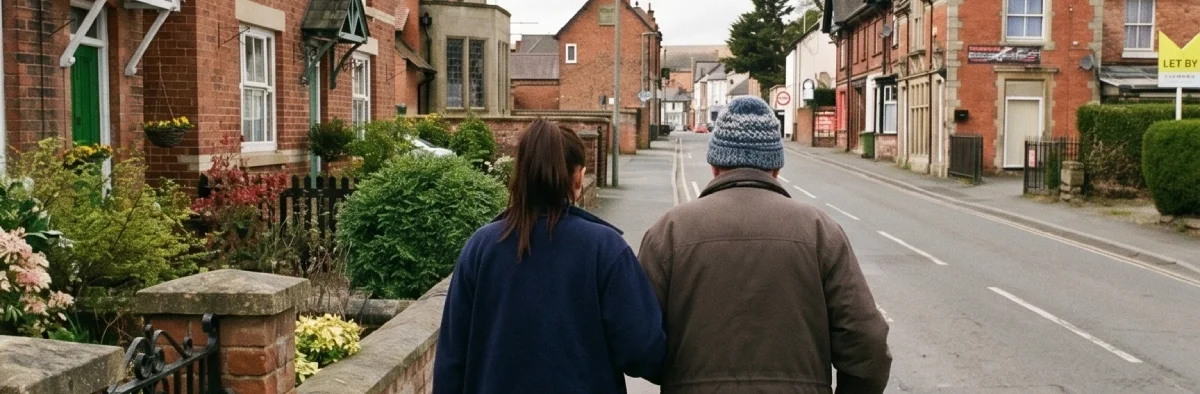
At North Shropshire Homecare, we think about this carefully. Not as a box-ticking exercise in political correctness, but because the families and individuals who trust us deserve to know that the people coming into their homes have genuinely considered what it means to treat someone with dignity. That consideration starts with the words we use before we even knock on the door.
Here, as honestly as we can put it, is how we think about language — and why it matters more than it might first appear.
"Client" or "Service User" — Not "Patient," Not "The elderly"
We say: Client. We avoid: Patient. The elderly. The vulnerable.
A patient is someone receiving medical treatment — defined by their illness, temporarily under clinical authority. That is appropriate in a hospital. It is not appropriate in someone's own home, where they are the householder and we are the visitor.
"The elderly" and "the vulnerable" are perhaps the most insidious of all, because they collapse individuals into a category. The 79-year-old retired headteacher in Wem who ran a school for thirty years, raised four children, and still does the Times cryptic crossword every morning is not "the elderly." She is Margaret. She happens to need help with her medication. These are not the same thing.
"Client" is imperfect — no word is perfect — but it preserves something important: the idea that the person has chosen to engage with us, has agency in that choice, and remains in charge of their own life. We work for them. Not the other way around.

First Names and Titles — Always Ask, Never Assume
We say: "How would you like us to address you?" We avoid: Defaulting to first names without permission. "Love," "dear," "sweetheart."
This one surprises people sometimes. In a culture that has become broadly informal, calling someone by their first name feels friendly and warm rather than presumptuous. And for many people — perhaps most — it is. Many clients positively prefer it and say so immediately.
But not all of them. And the ones who don't are often the least likely to correct you, because they have spent a lifetime being polite and don't want to cause a fuss.
The retired bank manager who spent forty years being addressed as Mr Davies does not automatically become "Brian" because he now needs help getting dressed in the morning. The reduction in his physical capability is not an invitation to reduce his dignity along with it. If Brian wants to be called Brian, he will say so. If he doesn't, he will feel the assumption every single morning and say nothing.
We ask. Every time, with every new client. It takes ten seconds and it matters enormously.
As for "love" and "dear" — we understand the warmth intended. Some of our carers are from communities/generations where these are entirely natural terms of address and that’s OK. We ask our team to be mindful that what feels warm to the speaker can feel patronising to the recipient, particularly to younger people who associate these terms with being talked down to. Read the room. Follow the client's lead. When in doubt, use the name.
"Support" — Not "Manage," Not "Deal With"
We say: We support Margaret with her morning routine. We avoid: We manage Margaret. We deal with her personal care.
"Manage" is a word for problems, projects, and difficult situations. It implies that the person is something to be handled — a challenge to be navigated rather than a human being to be accompanied.
"Deal with" is worse. It carries the exhaustion of the speaker, the implication of burden. Nobody wants to be someone else's burden. Nobody wants to lie in bed waiting for a carer and overhear themselves being "dealt with."
"Support" preserves the correct orientation of the relationship. We are there to make something easier, to fill a gap, to stand alongside. The life remains the client's. We are in a supporting role — in the theatrical sense as much as the care sense.
This extends to how we talk about tasks. We do not "feed" clients. We support them to eat, or we assist with mealtimes, or — if someone genuinely cannot manage any aspect of eating independently — we help them eat. "Feed" is what you do to an infant or an animal. It implies passivity and dependence in a way that erases whatever capacity the person retains. Even if that capacity is only to choose between two options on a plate, or to hold a spoon for part of the meal, that capacity belongs to them and our language should reflect it.
"Living With" — Not "Suffering From"
We say: Margaret lives with dementia. We avoid: Margaret suffers from dementia. Margaret is a dementia sufferer. Margaret is afflicted with dementia.
Language shapes perception, and perception shapes care. When we describe someone as "suffering," we have already decided how their life feels to them — and we have decided it feels like suffering. That may sometimes be true, in particular moments. It is not the whole truth of a person's daily experience, and it should not be the frame through which a carer approaches a visit.
Many people living with dementia have mornings of real joy. They laugh. They remember. They have preferences and opinions and moments of profound connection. Describing them only through the lens of suffering denies all of that before the carer has even arrived.
"Living with" acknowledges the condition without making it the person's entire identity. It leaves room for the rest of who they are.
The same applies more broadly. "Lives with Parkinson's" rather than "Parkinson's sufferer." "Has a visual impairment" rather than "is visually impaired" — the person first, the condition second, always. This is sometimes called person-first language, and while it can occasionally feel slightly constructed in the flow of natural speech, the instinct behind it is sound: the person is not defined by their diagnosis.
"Declined" — Not "Difficult," Not "Won't"
We say: Mr Davies declined his morning wash today. We avoid: He was uncooperative. He won't cooperate. He's being difficult.
This one is specifically for documentation and handover notes, but it matters as much as anything else on this list — perhaps more, because the language in a care record shapes how every subsequent carer approaches that person.
"Being difficult" and "won't cooperate" carry a judgment. They position the client as the problem in a conflict between the carer's intention and the client's will. They suggest that the correct outcome was the carer's plan, and the client deviated from it.
In reality, a person declining personal care on a particular morning is exercising autonomy over their own body. That is not being difficult. That is a choice. Our job is to document the choice, explore whether there is an underlying reason — pain, anxiety, a change in condition — and respect it. Not to frame it as obstruction.
The language we use in notes follows a client through their care journey, potentially for years, and is read by other carers, by family members, by social workers, by CQC inspectors. A person described repeatedly as "not willing" or "difficult" will be approached differently — with lower expectations, with less patience, with a framework of conflict already in place. A person described as having "declined" or "expressed a preference not to" is approached as someone with a point of view worth understanding.
Same behaviour. Very different futures.

"Home" — Always Their Home, Never "The Property"
We say: In Margaret's home. We avoid: At the property. At the address. In the client's residence.
This is perhaps the smallest item on this list, and perhaps the most telling.
A home is a place that belongs to someone. A property is an asset. A residence is an administrative location. When we talk about a person's home as "the property" or "the address," we have — in three words — removed them from it. We have turned the place where they have lived their life, where their photographs are on the wall and their garden is exactly as they like it, into a location on a rota.
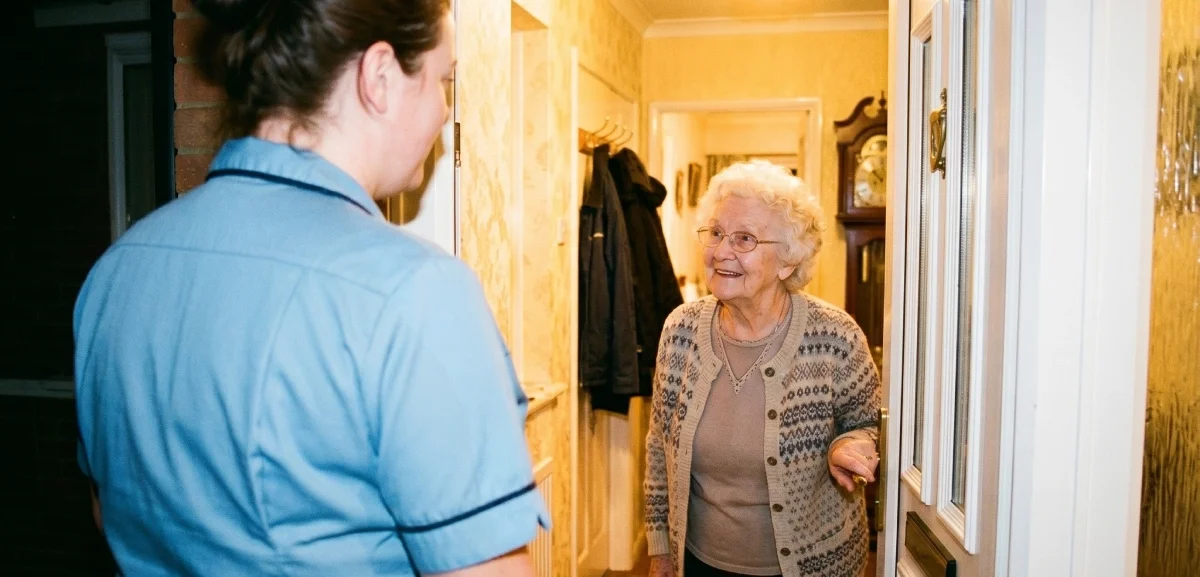
We visit people in their homes. We are guests. We behave accordingly — wiping our feet, asking before we move things, treating the space with the respect owed to someone else's sanctuary.
The language that reminds us of this is the language that keeps us honest about what we are actually doing every time we knock on a door.
Why This Matters Beyond Words
We want to be honest about something. Getting the language right does not, on its own, make someone a good carer. You can say all the right words and still rush, still be distracted, still fail to notice the thing that needed noticing. Language is not a substitute for genuine care.
But it is a symptom of it.
The carers who naturally use person-first language, who default to titles until told otherwise, who write "declined" rather than "won’t do it" — these are almost always the carers who also slow down at the right moment, who notice the thing that isn't on the care plan, who leave a client feeling more like themselves than they did before the visit.
Language and values travel together. Changing one, over time, changes the other.
This is why we talk about it with every new member of our team. Not as a rule to follow but as an expression of something we actually believe: that the people who welcome us into their homes on the most difficult mornings of their lives deserve to be seen, accurately and completely, for who they are.
Not patients. Not the elderly or the vulnerable or the difficult or the ones who won't cooperate.
People. With names they have earned, lives they have built, and homes that still belong entirely to them.
That is who we are visiting.
North Shropshire Homecare has been providing home care in Whitchurch, Wem, Prees, Whixall, Higher Heath, Ash, and the surrounding villages of North Shropshire since 2011. CQC rated Good. Independently owned. Locally staffed. Highly rated.
North Shropshire Homecare
The Coach House, 15/17 Green End, Whitchurch, SY13 1AD Tel: 01948 411222 | mail@nshomecare.co.uk