
Ten More Questions Nobody Asks — But Almost Everyone Thinks Part 2
The second in our series of questions that tend to live in the back of people's minds rather than on the contact form.
1. Do your carers actually like their clients — or is it just a job?
It is both, and the honest answer is that this is not a contradiction.
Professional care is a job. Our carers are employed, trained, paid, and managed. They operate within a professional framework and they go home at the end of their shift. This is not a limitation of the care they provide — it is what makes it reliable, consistent, and safe. A carer whose emotional involvement with a client has no professional boundary is not actually safer for the client. They are more vulnerable, more liable to burnout, and less able to make clear-headed decisions when difficult situations arise.
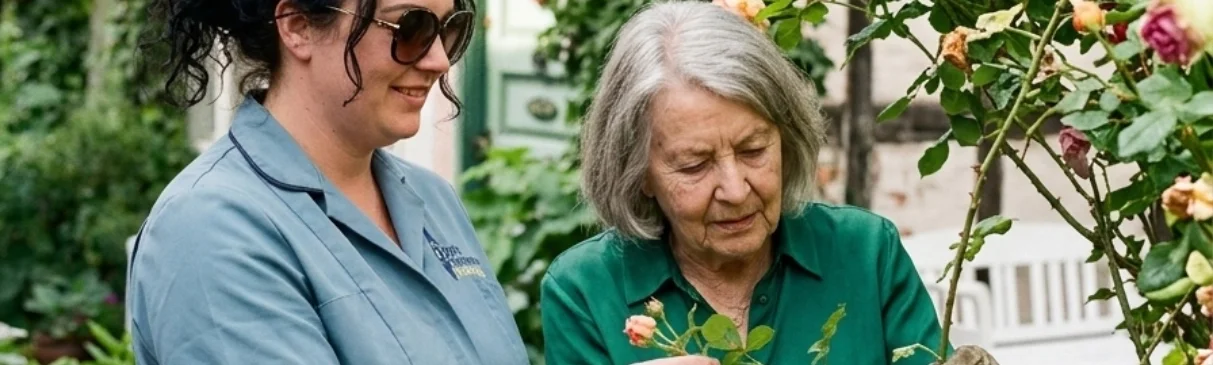
Within that professional framework, something else happens that we think is worth being honest about. When you spend months visiting the same person at 8am, learning how they take their tea and what makes them laugh, knowing the names of the grandchildren from the photographs on the mantelpiece and which topics reliably lift the mood on a difficult morning — you develop genuine warmth for that person. Not the same as family love. Something different. A professional care relationship that, at its best, has real humanity in it.
Our carers would not do this work — for the pay rates the sector offers, in rural North Shropshire lanes in January — if they did not, at some level, mean it. That doesn't make every visit a profound emotional experience. Some mornings are quiet and functional. That is fine too. But the people we support are not interchangeable to us, and the ones we have known longest are the ones we think about when they are in hospital and ask after when they come home.
2. What if my relative is unkind to me but fine with the carer?
This is one of the most quietly painful things families experience, and one of the least discussed.
It is genuinely common. A parent who is patient, cooperative, and warm with the carer is sharp, resistant, or dismissive with the adult child who has been managing their care for months. A spouse who accepts help gracefully from a professional becomes angry and rejecting when their partner tries to do the same thing.
There are several reasons this happens, and none of them mean the family member is doing anything wrong.
The first is safety. People tend to save their worst behaviour for the people they feel safest with. A parent who is difficult with their adult child is, on some level, certain enough of that child's love to risk expressing distress, frustration, and fear. The carer gets the performed version. The family gets the real one.
The second is identity. Accepting help from a professional is categorically different from accepting help from a child. One is a transaction — someone paid to assist. The other is a confrontation with dependency, with the reversal of the parent-child dynamic, with the evidence of decline in the eyes of someone who knew you at your strongest. That is much harder to accept gracefully.
The third, in dementia specifically, is recognition. A carer is a known, consistent, non-threatening figure. A family member who visits irregularly or who arrives with visible worry may trigger agitation simply through the emotional charge they carry into the room.
None of this makes it easier to be on the receiving end of. But understanding it sometimes helps. And if it helps to hear it from us: you are almost certainly not the problem.
3. What do carers actually think when they first walk into someone's home?
We asked. Here is what they told us.
The first thing most experienced carers notice is the smell. Not in a judgmental way — as information. A home that smells different from last week is the first signal that something may have changed. Staleness, sweetness, ammonia, the absence of recent cooking — all of these tell a carer something before they have spoken a word.
After that: the temperature. Is the heating on? Is it appropriate for the season? A very cold house in February or a very hot house in June is worth noting.
Then: the person. How are they standing? How do they move to the door? Are they dressed? Does their presentation match the time of day? Are they glad to see the carer, or agitated, or somewhere else entirely?
Then: the environment. Is the floor clear? Has anything shifted since the last visit? Is the medication where it should be? Is there food?
This is all happening in the first thirty seconds, before the kettle goes on and the conversation begins. It is not surveillance. It is the professional attentiveness that makes home care genuinely protective rather than simply task-based. The carer who walks in already paying attention is the carer who notices the thing that matters.
4. Does having a carer make people give up on doing things for themselves?
This is a genuine concern and it deserves a genuine answer rather than blanket reassurance.
The research on this is nuanced. Poorly designed care — where a carer does everything regardless of what the person can manage — does contribute to reduced independence over time. This is called learned helplessness, and it is a real phenomenon. A person who is never given the opportunity to pour their own cup of tea, or choose their own clothes, or wash their own face, loses those abilities faster than someone who is supported to retain them.
This is why our approach to care is built around the question: what can this person do, and how do we make space for it? We prompt before we assist. We assist before we complete. We follow the person's lead on what they want help with and what they want to do themselves. We try to resist the carer instinct to do things efficiently, because efficiency and independence are sometimes in tension, and independence should win.
The honest caveat: some loss of independence over time reflects the progression of an underlying condition, not the effect of care. Distinguishing between the two requires attention and honesty. If you believe that a care arrangement is contributing to a relative's decline in independence rather than supporting their retained abilities, please raise it with us. We would rather know.
5. What happens if our carer gets ill during a visit?
It has happened. Rarely, but it has.
If a carer becomes unwell during a visit, they call the office immediately and we send cover as quickly as possible. The carer's first responsibility is to ensure the client is safe — seated comfortably, not mid-transfer, not in any immediate risk — before managing their own situation. They do not simply leave.
The client is informed honestly and calmly. We do not pretend the carer has had to leave for another reason. We explain what has happened, confirm when replacement support will arrive, and check that the client is comfortable in the interim.
This is the kind of scenario that a protocol exists for precisely because handling it well in the moment is very difficult if nobody has thought about it in advance. We have thought about it in advance.
6. Is my relative's home being judged when carers visit?
Not in the way you might fear.
Carers are not visiting to assess cleanliness standards or form opinions about how someone keeps their house. They are visiting to support a person, and the home is the context for that — not the subject of it.
What carers do notice, professionally, is anything that affects the safety or the care of the person. A cluttered hallway that has become a fall risk. A refrigerator that has not been properly emptied for some time. A bathroom that has developed mould that might affect a respiratory condition. These observations go into the care record and are raised with the family or office when relevant.
They do not go into judgment. They do not become the topic of conversation between carers except as clinical information. The standard we hold ourselves to is this: would we raise this observation with the same professionalism and discretion if it were our own family's home? The answer has to be yes.
For family members who worry about what a carer thinks when they see a house that has slipped below the standard it was once kept to — that slippage is usually the evidence of need, not a reflection of the person or their family. We see it as information, not indictment.
7. Can I ask a carer to keep something from the rest of the family?
We need to be careful here and we want to be honest about why.
If a client asks their carer to keep information from family members — information about their health, their wishes, a change in their circumstances — the first question is one of mental capacity. A person with full mental capacity has the right to control their own information. What they tell their family is their business, not the carer's. Carers are not family informants, and they are not required to share information about a client with family members who do not hold a Lasting Power of Attorney.
Where it becomes more complex is when the information being kept involves risk. A client who asks a carer not to mention a fall to their daughter, because they do not want to worry her, is asking the carer to collude in something that may mean a dangerous situation goes unaddressed. In that case the carer's obligation is to the client's safety, which may override the client's preference for privacy on that specific issue.
We navigate this carefully and we are transparent with both clients and families about the principles involved. Our carers are not caught between clients and families — they are on the side of the person's wellbeing, which is almost always the same as honesty.
If you are a client who wants to talk to us confidentially — without the conversation going back to family — call the office directly. We will tell you honestly what we can and cannot keep between us.
8. Do carers get sad when a client dies?
Yes. Of course they do.
We said something about this in the previous post. We want to say a little more here because we think it matters.
The grief that carers feel when a client dies is real, but it exists in a strange social space. There is no formal bereavement leave for a client death. The carer is not a relative and may not attend the funeral. The world does not particularly acknowledge that anything has happened to them.
Meanwhile they may have visited that person every morning for three years. They may have been the last person to see them before death. They may have noticed the change in the final week and known, quietly, what it meant.
At NSHC we take this seriously. We debrief with carers after a client death. We acknowledge it as a loss. We give carers space to feel it without having to pretend it is simply a professional event that has been processed and filed.
We also think it is worth families knowing this. When a long-term client dies, the carers involved often carry a genuine sense of loss. A message to the office — even a brief one — that acknowledges this is received with more gratitude than you might expect. The relationship was real on both sides.
9. What if home care is clearly not working but my relative refuses anything else?
This is one of the hardest situations in care, and there is no answer that makes it comfortable.
When an adult with mental capacity makes a decision about their own life and care that others believe is unwise or unsafe, they are generally entitled to make it. The principle of self-determination means that a person who understands the risks, understands the alternatives, and still chooses to stay at home against professional advice has the right to do so. We cannot override that choice. Neither can their family.
What we can do is be honest about the risks, document them clearly, ensure the person has been properly informed, and continue providing the best care we can within the situation that exists rather than the one we would prefer.
What families can do is continue the conversation — not as a campaign to override the person's decision, but as an ongoing, gentle dialogue that keeps the options visible and the door open. Decisions made in one set of circumstances can change as circumstances change. A person who is fiercely resistant to residential care at 82 may feel differently at 85 after a second fall. The goal is not to win the argument today but to remain someone they trust enough to talk to when the position shifts.
The situation that is genuinely serious is when a person's capacity to make an informed decision is in doubt. If you believe that a relative is making decisions about their care without understanding the risks — due to dementia, or significant mental illness, or another condition affecting capacity — then a formal mental capacity assessment, arranged through the GP or social services, is the appropriate next step. This is not about overriding someone. It is about establishing whether they are in a position to make the decision in the first place.
10. After everything — is home care actually worth it?
We are the wrong people to answer this without bias, and we know it. So we will tell you what we observe rather than what we advocate.
We see people stay in their homes for years longer than would otherwise have been possible. We see people who were deteriorating — isolated, malnourished, falling, losing their grip on daily life — stabilise and sometimes genuinely improve when consistent, attentive care arrives. We see family carers who were heading toward collapse find that they can sustain what they were doing, with support, for considerably longer than they thought.
We also see situations where it is not enough. Where the needs exceed what visiting care can meet. Where families have held on too long past the point where home was genuinely the right place, because the idea of the alternative was too painful to face. We have been honest about this in the previous post and we remain honest about it here.
The question of whether home care is worth it is really several questions at once: worth it financially, worth it emotionally, worth it in terms of quality of life for the person receiving it and the family managing it.
What we can tell you, without reservation, is that the best home care — delivered consistently, by people who know the individual, in a way that treats them as a whole person rather than a list of tasks — is one of the most valuable and humane interventions available to an ageing person. Not because we provide it. Because of what it makes possible: a person, in their own home, with their own things around them, living their own life until the end of it.
That is worth a great deal.
If these questions have surfaced something you want to talk through — about your situation, your relative, or simply what you are worried about — we are here.
📞 01948 411222 — Monday to Friday, 9am to 4pm, or 24 hours for anything urgent. ✉️ mail@nshomecare.co.uk
There are no wrong questions. Only the ones that don't get asked.
North Shropshire Homecare The Coach House, 15/17 Green End, Whitchurch, SY13 1AD
Providing home care in Whitchurch, Wem, Prees, Whixall, Higher Heath, Tilstock, Ash, and the surrounding villages of North Shropshire since 2011. CQC rated Good. Independently owned. Locally staffed.