
Training Tuesday: What Urine Can Tell You
Before We Start Evaluating Urine
This is one of those topics nobody particularly wants to discuss, and one of the most useful observations a carer can make every single day. Urine colour, clarity, and smell are a simple, free, constantly available window into hydration, kidney function, infection, and sometimes far more serious things, and noticing changes early can prevent a small problem becoming a genuine crisis.
This isn't about making anyone self-conscious or embarrassed. It's a completely ordinary, matter-of-fact part of good daily observation, exactly like checking someone's skin or their appetite.
The Colour Chart
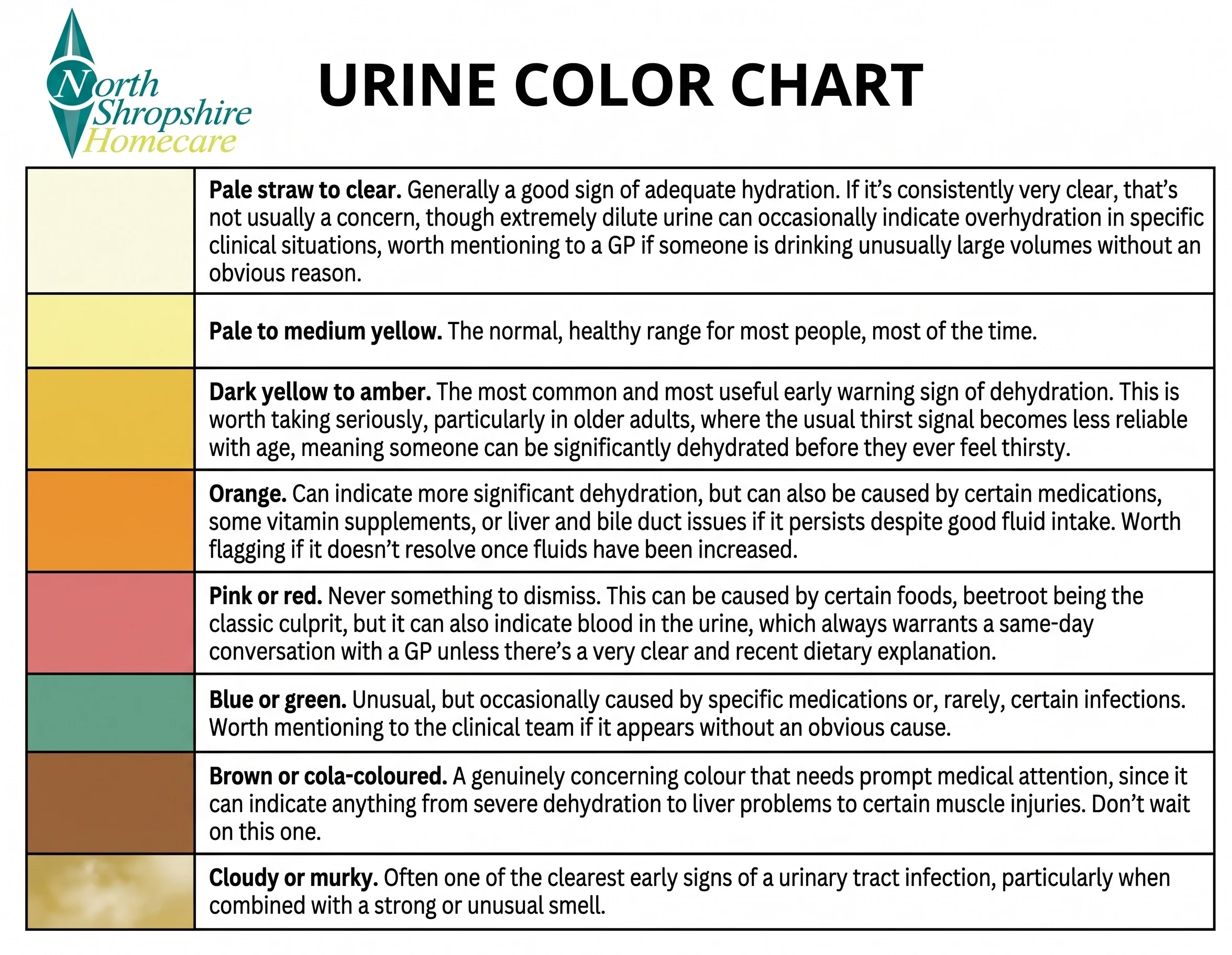
What Colour Actually Tells You
Pale straw to clear. Generally a good sign of adequate hydration. If it's consistently very clear, that's not usually a concern, though extremely dilute urine can occasionally indicate overhydration in specific clinical situations, worth mentioning to a GP if someone is drinking unusually large volumes without an obvious reason.
Pale to medium yellow. The normal, healthy range for most people, most of the time.
Dark yellow to amber. The most common and most useful early warning sign of dehydration. This is worth taking seriously, particularly in older adults, where the usual thirst signal becomes less reliable with age, meaning someone can be significantly dehydrated before they ever feel thirsty. See our earlier piece on hydration for more detail on why this matters so much in this age group specifically.
Orange. Can indicate more significant dehydration, but can also be caused by certain medications, some vitamin supplements, or liver and bile duct issues if it persists despite good fluid intake. Worth flagging if it doesn't resolve once fluids have been increased.
Pink or red. Never something to dismiss. This can be caused by certain foods, beetroot being the classic culprit, but it can also indicate blood in the urine, which always warrants a same-day conversation with a GP unless there's a very clear and recent dietary explanation.
Blue or green. Unusual, but occasionally caused by specific medications or, rarely, certain infections. Worth mentioning to the clinical team if it appears without an obvious cause.
Brown or cola-coloured. A genuinely concerning colour that needs prompt medical attention, since it can indicate anything from severe dehydration to liver problems to certain muscle injuries. Don't wait on this one.
Cloudy or murky. Often one of the clearest early signs of a urinary tract infection, particularly when combined with a strong or unusual smell.
Beyond Colour — What Else to Notice
Smell. A strong, unusually pungent smell, particularly a sudden change from someone's normal baseline, is frequently one of the earliest signs of a UTI, sometimes appearing before any other symptom at all.
Frequency and urgency. A sudden increase in how often someone needs the toilet, or new urgency that wasn't there before, is worth documenting and mentioning.
Pain or discomfort. Any reported pain or burning during urination should be raised promptly rather than monitored quietly.
Volume. A noticeable and sustained drop in how much urine someone is passing can indicate dehydration or, in more serious cases, kidney function concerns.
Why This Matters More Than People Realise
We've written before, in several places across this site, about how urinary tract infections in older adults, and particularly in people with dementia, very often present as sudden confusion rather than the pain or burning most people expect. A relative who becomes unexpectedly muddled, agitated, or simply "not themselves" over a day or two may be showing the first sign of an infection long before any of the more obvious urinary symptoms appear. Checking urine colour and clarity in that moment can be one of the fastest, simplest ways to work out whether that's what's actually happening.
This is exactly why we build urine observation into personal care and continence support as a matter of routine, not an afterthought. It costs nothing, takes seconds, and consistently catches things early.
Condition-Specific Notes
Dementia — as above, sudden confusion with no other obvious cause should always prompt a check for possible UTI, urine colour and smell being the quickest first clue. See our Dementia Care and Support page.
Heart failure — urine output and colour changes matter here for a different reason, tied closely to fluid balance and diuretic medication. A sudden drop in output alongside increasing breathlessness or swelling is a pattern worth flagging immediately. See our Heart Failure and Cardiac Care page.
Diabetes — persistently cloudy or unusually sweet-smelling urine can be relevant to blood glucose control and infection risk, both of which matter considerably in this group.
Stoma and urostomy care — colour and clarity checks apply directly here too, and are one of the simplest ongoing monitoring tools for anyone with a urinary diversion. See our Stoma Care page.
Frailty and reduced mobility — anyone with limited fluid intake due to reduced independence in reaching drinks is at higher dehydration risk, making regular colour checks a genuinely useful early warning system. See our Frailty and Arthritis Care page.
If You Want to Learn Properly
This is exactly the kind of quiet, consistent observation we cover thoroughly in every carer's induction at The Coach House. If noticing the small details that others might miss sounds like something you'd take genuine pride in, have a look at our Careers page.
📞 01948 411222
✉️ mail@nshomecare.co.uk
North Shropshire Homecare
The Coach House, 15/17 Green End, Whitchurch, SY13 1AD