
Adaptive Clothing — Making Dressing Easier, Explained Condition by Condition
What it is, where to find it, and why it matters more than people realise across every condition we support.
Getting dressed is one of those tasks most of us do without thinking. Reach, pull, fasten, done — a few minutes, no mental effort involved. For a lot of the people we support in North Shropshire, that same task has quietly become one of the hardest, most exhausting, or most frustrating parts of the day.
Adaptive clothing exists to close that gap. It isn't a niche product category or a compromise on style — increasingly it's genuinely well-designed clothing that happens to remove the specific barriers that tremor, reduced dexterity, cognitive change, or physical limitation put in the way of an ordinary morning routine.
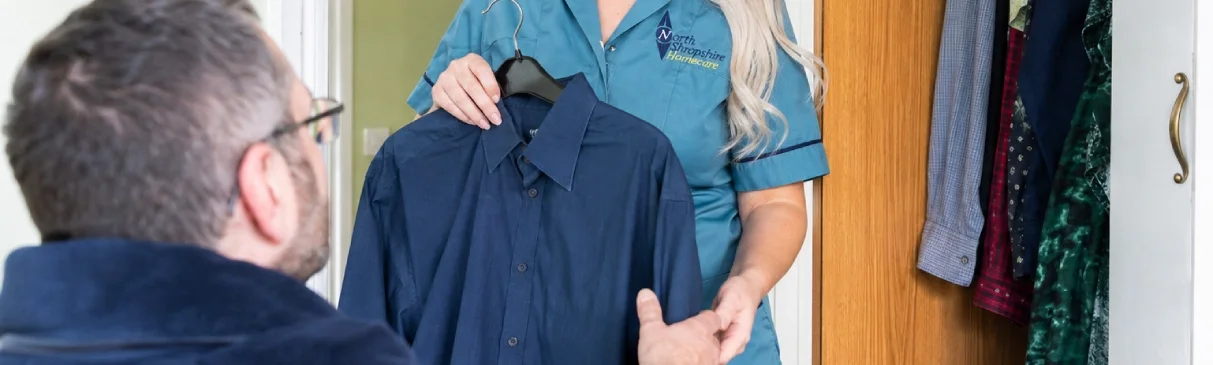
We were prompted to write this after reading a genuinely useful piece from the Huntington's Disease Association on exactly this subject — it flagged something significant: Primark has launched an adaptive clothing range, available in store and online, which is a meaningful step toward adaptive clothing becoming mainstream and affordable rather than a specialist, expensive niche.
What we want to add here is the detail the HDA piece doesn't cover — how each specific feature actually maps onto the conditions we support every day, because "adaptive clothing helps" is true, but it's more useful to know exactly why and for whom.
What Adaptive Clothing Actually Is
The core features worth knowing, all of which we'll come back to throughout this post:
Magnetic fastenings — replacing buttons with magnets hidden inside the fabric, so a garment looks conventional from the outside but requires no fine finger movement to close.
Velcro and easy-close alternatives — for shoes, trousers, and tops where a zip or button would otherwise demand grip and coordination the person no longer has reliably.
Stretch fabrics — allowing a garment to be pulled on and off with far less range of motion and far less resistance than a rigid, woven fabric.
Wider openings — for arms, legs, and necklines, reducing the precision needed to guide a limb through an opening.
Softer, seam-reduced materials — for anyone with sensory sensitivity, fragile skin, or a condition where ordinary seams and labels become genuinely uncomfortable rather than a minor irritation.
None of these features are complicated. What's changed in recent years is that they're increasingly available in clothing that looks entirely ordinary — which matters enormously, because dignity and self-image don't stop mattering just because dressing has become difficult.
Parkinson's Disease
Tremor and bradykinesia — the slowness of movement that characterises Parkinson's — make small fastenings genuinely difficult. A shirt button that took two seconds a decade ago can take several frustrating minutes now, particularly first thing in the morning before medication has taken full effect.
What helps: Magnetic fastenings remove the fine motor demand of buttons almost entirely. Elastic waistbands avoid the two-handed coordination a belt or button-fly requires. Velcro shoe fastenings solve one of the most commonly reported daily frustrations for people with Parkinson's-related hand tremor. Loose, stretch-fabric tops reduce the arm-raising and precise guidance that a fitted garment demands — which matters because arm-raising can itself be a trigger for increased rigidity in some people.
See our full Parkinson's Disease Care page for more on how we support the wider daily routine around this.
Multiple Sclerosis
MS presents differently for almost everyone who has it, but hand weakness, spasticity, fatigue, and heat sensitivity all affect dressing in specific, predictable ways.
What helps: Stretch fabrics accommodate the day-to-day variability of MS — a garment that fits and functions well on a good day needs to still be manageable on a day with more spasticity or fatigue. Front-fastening garments reduce the awkward reaching behind the back that can be genuinely difficult with reduced shoulder mobility or spasticity. Lightweight, breathable fabrics matter more than people realise for MS specifically, because Uhthoff's phenomenon — the temporary worsening of symptoms with increased body heat — means heavy or restrictive clothing can measurably worsen how someone feels for the rest of the day.
See our Multiple Sclerosis Care page for the fuller picture on managing fatigue and heat sensitivity.
Stroke Recovery
Hemiplegia — one-sided weakness following stroke — makes conventional clothing genuinely difficult to manage with only one fully functioning side.
What helps: Front-opening garments with magnetic or Velcro fastenings allow a stroke survivor to dress largely independently using their unaffected hand, rather than needing full assistance for every layer. Wider armholes and looser cuffs make guiding a weak or spastic arm through a sleeve considerably easier and less painful, particularly given the shoulder subluxation risk we cover elsewhere on this site. Trousers with elastic waistbands and side fastenings avoid the two-handed manoeuvre a button-fly demands.
The sequence matters as much as the clothing itself here — affected limb first when dressing, unaffected limb first when undressing — but adaptive clothing makes that sequence considerably less effortful. More detail on our Stroke Recovery Care page.
Cerebral Palsy
For adults with CP, particularly those with spasticity or involuntary movement, dressing has often been a daily challenge managed through decades of personal technique — and adaptive clothing needs to work with that established approach, not override it.
What helps: Stretch, seam-reduced fabrics reduce the friction and resistance that spasticity fights against during dressing. Wider necklines and armholes accommodate the unpredictable positioning that dyskinetic movement can involve. For people who spend significant time in a wheelchair, clothing cut specifically for a seated position — higher back rise, reduced bulk at the seams that would otherwise create pressure points — matters considerably for comfort and, more importantly, for skin integrity.
Full detail on our Cerebral Palsy Care page.
Huntington's Disease
This is the condition the HDA's own article addresses directly, and for good reason — chorea, the involuntary movements characteristic of HD, make dressing with standard clothing a specific and considerable daily challenge that changes as the disease progresses.
What helps: Everything the HDA piece highlights applies directly here — magnetic fastenings and Velcro remove the need for the fine motor control that chorea disrupts. Loose, stretch clothing accommodates sudden involuntary movement without tearing or becoming genuinely difficult to manage mid-task. In later stages, where cognitive changes affect the ability to sequence a dressing routine, simpler garments with fewer separate pieces and fewer decisions genuinely reduce distress, not just physical difficulty.
Full detail on our Huntington's Disease Care page.
Motor Neurone Disease
As MND progresses, the muscle weakness that affects mobility and breathing also, inevitably, affects the ability to manage clothing — often earlier and more significantly than families expect.
What helps: Magnetic and Velcro fastenings become essential rather than optional as hand and grip strength declines. Front-opening garments reduce the need for the kind of overhead arm movement that becomes genuinely difficult with respiratory muscle weakness — raising both arms above the head to pull a jumper on is a meaningfully different physical demand from someone without MND, and it's worth avoiding where possible. Soft, seam-free fabrics matter for comfort where NIV mask straps or other equipment create pressure points that ordinary clothing seams can aggravate further.
Full detail on our Motor Neurone Disease Care page.
Spinal Cord Injury
Adaptive clothing needs differ considerably by injury level, but a few needs are close to universal.
What helps: For anyone using a wheelchair, clothing cut for a seated position — a longer rise at the back, reduced bulk in the seams — significantly reduces pressure point risk, which matters given how seriously we take pressure area prevention across every condition we cover. For tetraplegic clients with limited or no hand function, magnetic and Velcro fastenings aren't a convenience, they're often the difference between some independence in dressing and none. Front-opening tops avoid the need to raise arms overhead, which is often not physically possible depending on injury level.
Full detail on our Spinal Cord Injury Care page.
Arthritis and Frailty
This is where adaptive clothing has arguably the widest reach of any condition we cover, because arthritis in the hands specifically attacks the exact fine motor tasks that ordinary clothing assumes you can do without thinking.
What helps: Magnetic fastenings and elastic waistbands solve the single most commonly reported daily frustration among people with hand osteoarthritis or rheumatoid arthritis — buttons and zips that were effortless for decades and are now genuinely painful. Velcro shoes remove the need to bend, reach, and tie with hands that may not tolerate the grip required. For rheumatoid arthritis specifically, where morning stiffness is often at its worst in exactly the hour dressing needs to happen, adaptive clothing can meaningfully reduce both the pain and the time the whole routine takes.
Full detail on our Frailty and Arthritis Care page.
Vision and Hearing Loss
Adaptive clothing helps here in a different way — less about physical dexterity, more about reducing the cognitive and visual load of getting dressed independently.
What helps: Clothing with distinct, high-contrast colours and simple, consistent styles makes independent outfit selection considerably easier for someone with significant vision loss. Tactile fastening differences — Velcro that feels distinctly different from a zip — help someone navigate a garment by touch rather than sight. For clients with dual sensory loss, simplifying the entire dressing process through easy, predictable fastenings reduces the frustration that comes from not being able to see or reliably feel what's going wrong.
Full detail on our Vision and Hearing Loss Care page.
Stroke, Cancer Recovery, and Stoma Care
A few of our conditions have specific clothing needs worth mentioning separately.
Post-surgical and orthopaedic recovery — following hip or knee replacement, clothing needs to work within movement precautions. Elastic waistbands and front-opening tops avoid the twisting and reaching that hip precautions specifically prohibit. See our Post-Surgical and Orthopaedic Recovery page.
Stoma care — clothing that sits away from the stoma site, with a soft, non-restrictive waistband, genuinely matters for comfort and for protecting the appliance seal. High-waisted, stretch-fabric options avoid the pressure a standard waistband can put directly across a stoma. See our Stoma Care page.
Cancer treatment — for anyone managing a PICC line, a portacath, or significant fatigue during chemotherapy, front-opening and easy-access clothing around the chest and arms avoids unnecessary discomfort and difficulty. See our Cancer Care page.
Where to Find Adaptive Clothing
The good news is that this category has genuinely opened up in recent years. Shops have started to bring magnetic fastenings, stretch fabrics, and wider openings to high street prices — a significant shift from a market that was, until recently, dominated by specialist retailers charging considerably more.
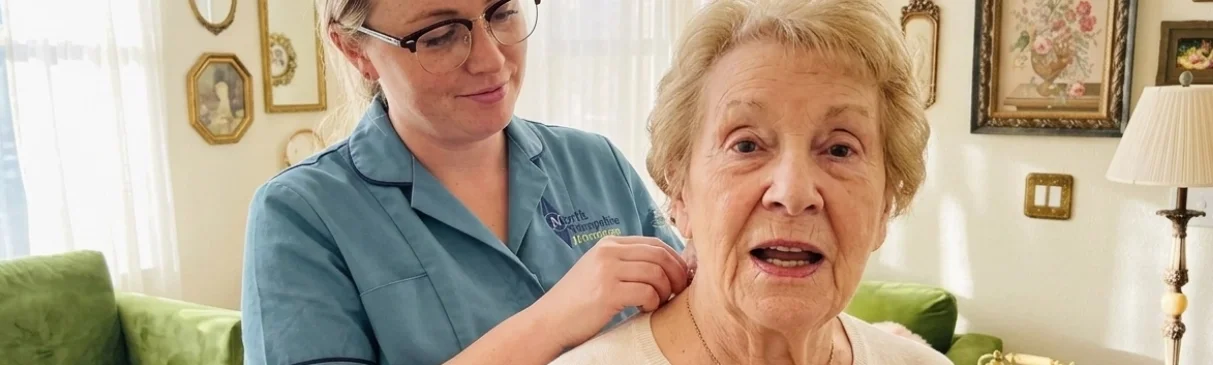
Beyond Primark, Tommy Hilfiger, M&S, and Marks & Spencer's own adaptive ranges, along with specialist retailers like Independence Day Clothing, all offer genuinely well-designed options. We're always glad to talk through what might suit a specific situation if you're not sure where to start — our carers see, every single day, what actually works in practice for the conditions we support.
A Final Note From Us
We don't endorse specific brands or products, and what works brilliantly for one person may not suit another — everyone's needs, and everyone's sense of what still feels like "them," are different. What we'd say, echoing the HDA's own advice, is that dignity and choice matter every bit as much as function. Adaptive clothing at its best doesn't look adaptive. It looks like clothing someone chose, that happens to work with their body rather than against it.
If dressing has become a daily source of frustration or discomfort for you or someone you love, it's worth raising with us directly — our carers can offer practical, condition-specific advice drawn from what we actually see working, every day, across North Shropshire.
📞 01948 411222 ✉️ mail@nshomecare.co.uk
North Shropshire Homecare The Coach House, 15/17 Green End, Whitchurch, SY13 1AD